Wolf Spiders in South Carolina: Identification, Season & Prevention
Quick Answer: Wolf spiders in South Carolina are common, with 1,115 verified GBIF sightings concentrated in Richland, Berkeley, Greenville, Horry, and Charleston counties. They are considered a nuisance rather than a danger, and activity peaks in April, May, August, and September. Simple exclusion and moisture control keep most of them outdoors where they belong.
When Wolf Spiders Are Most Active in South Carolina
Now (November): Moderate ActivityVerified South Carolina Counties, Species & US Range
Counties with Verified Observations
- Richland
- Berkeley
- Greenville
- Horry
- Charleston
- Colleton
- Pickens
- Beaufort
- Spartanburg
- Georgetown
Species Recorded in South Carolina
| Species | Scientific Name | GBIF Records |
|---|---|---|
| Rabid Wolf Spider | Rabidosa rabida | 329 |
| Georgia Wolf Spider | Tigrosa georgicola | 223 |
| Tigrosa annexa | Tigrosa annexa | 196 |
How South Carolina Compares to Neighboring States
Note: Wildlife does not follow state or county lines. GBIF totals reflect verified citizen and museum records, so low counts in a neighboring county do not guarantee absence.
How to Identify Wolf Spiders
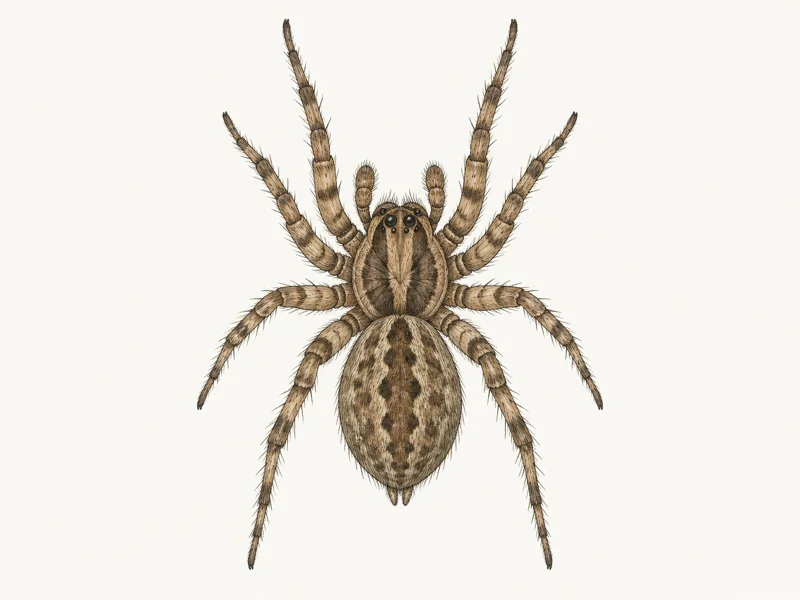
Annotated Anatomy Key (Wolf Spider)
- Large front eyes: Eight eyes in 3 distinct rows (two very large middle eyes reflect flashlight beams at night).
- Striped cephalothorax: Robust front carapace marked with twin dark lengthwise stripes—no recluse violin mark.
- Eight stout hairy legs: Four pairs of strong, spiny, mottled hunting legs built for chasing prey without webs.
- Mottled oval abdomen: Patterned brown-and-tan abdomen; females carry round egg sacs attached to spinnerets.
Wolf Spiders Field Checklist
- Stout, hairy brown-and-gray striped spider with prominent spiny legs
- Two notably large forward-facing eyes above a row of four tiny eyes (reflects flashlight beams at night)
- Hunts actively on the ground without spinning prey-catching webs
- Females uniquely carry round silk egg sacs on their spinnerets and piggyback spiderlings
Wolf Spiders Size at True Relative Scale
Quick Answer: Wolf spiders in South Carolina are common, with 1,115 verified GBIF sightings concentrated in Richland, Berkeley, Greenville, Horry, and Charleston counties. They are considered a nuisance rather than a danger, and activity peaks in April, May, August, and September. Simple exclusion and moisture control keep most of them outdoors where they belong.
Where Wolf Spiders Live in South Carolina
For anyone asking, "Are there wolf spiders in South Carolina?", the answer is a firm yes. Wolf spiders (family Lycosidae) thrive in the state's humid subtropical climate, which spans USDA hardiness zones 7a through 9a. Hot, muggy summers and mild coastal winters give these ground hunters a long active season.
GBIF occurrence records show the most sightings in these counties:
- Richland County – lawns, fields, and suburban yards around Columbia
- Berkeley County – wooded lots and wetland edges
- Greenville County – Upstate gardens and leaf litter
- Horry County – coastal landscapes and sandy soils
- Charleston County – Lowcountry yards, marsh edges, and crawl spaces
Unlike web-building spiders, wolf spiders hunt on foot. They hide under mulch, rocks, firewood, pine straw, and debris during the day, then roam at night in search of insects. Some species dig burrows in loose soil.
Species Recorded in South Carolina
- Rabid Wolf Spider (Rabidosa rabida) – a striped species often found in tall grass and low vegetation; despite the name, it is not aggressive.
- Georgia Wolf Spider (Tigrosa georgicola) – a large, dark, robust species that frequently wanders into garages and homes.
- Tigrosa annexa – a related ground-dwelling hunter in the same genus.
When Wolf Spiders Are Most Active in South Carolina
South Carolina wolf spider season has two clear peaks in GBIF data: April and May, then August and September. Spring activity follows warming soil and rising insect populations, while late summer brings mature males wandering in search of mates.
That late-summer roaming is why homeowners often find wolf spiders indoors in August and September. Heavy rain can also push them out of saturated ground and toward foundations. In mild coastal areas, some activity continues through winter on warm nights.
Look-Alikes Frequently Mistaken for Wolf Spiders
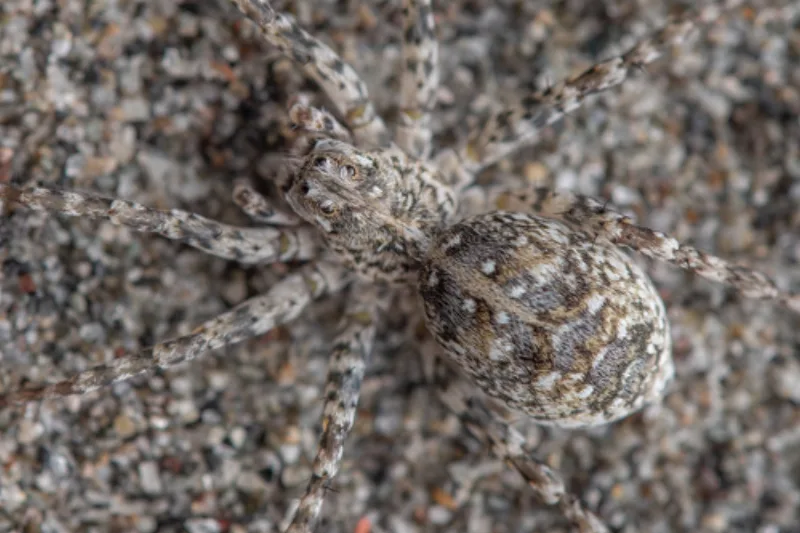
Accurate South Carolina wolf spider identification starts with the eyes. Wolf spiders have eight dark eyes in three rows, with two large forward-facing eyes that reflect flashlight beams as a green glow at night. Females carry an egg sac attached to their spinnerets and later carry spiderlings on their backs.
Tarantulas
Tarantulas are heavier-bodied and noticeably hairier, with thick legs and a slower, deliberate walk. Their eyes are small and clustered in a tight group on top of the head, without the large forward-facing pair typical of wolf spiders.
Other Spiders
Several other spiders in the state share brown, hairy appearances. Key differences include:
- Web use: Wolf spiders do not build capture webs; many look-alikes do.
- Speed: Wolf spiders sprint quickly across floors and lawns.
- Markings: Many wolf spiders show lengthwise stripes or mottled gray-brown patterns.
If a spider's identity is uncertain, a clear photo shared with a local extension office or a licensed professional can confirm it.
How to Keep Wolf Spiders Out of Your South Carolina Home
Knowing how to prevent wolf spiders in South Carolina comes down to Integrated Pest Management (IPM). University cooperative extension guidance consistently ranks exclusion, sanitation, and moisture control ahead of pesticides.
Exclusion
- Install door sweeps and repair weatherstripping on exterior doors.
- Seal foundation cracks and utility openings with caulk or copper mesh.
- Keep window and vent screens tight and intact.
- Close gaps around garage doors, a common entry point.
Sanitation and Habitat Reduction
- Pull mulch and pine straw several inches back from foundations.
- Store firewood off the ground and away from the house.
- Clear leaf litter, boards, and clutter from yards and garages.
- Use yellow or sodium-vapor outdoor bulbs to attract fewer insects, which reduces spider food.
Moisture Control
Fix leaky spigots, direct downspouts away from the foundation, and ventilate damp crawl spaces. Dehumidifiers help in basements and humid Lowcountry homes. Drier spaces support fewer insects and fewer hunting spiders.
Indoor Removal and Chemical Options
A single indoor wolf spider can be trapped under a cup and released outside, or picked up with a vacuum. Glue boards along walls help monitor activity. If pesticides are considered, use products labeled for spiders and always follow EPA product label directions exactly.
When to Call a Licensed South Carolina Pest Professional
- Spiders appear indoors daily despite sealing and cleanup.
- Many spiderlings are found, suggesting a heavy insect population inside.
- Crawl spaces or attics are hard to access safely.
- Other pests, such as crickets or cockroaches, are feeding the spiders.
Choose a pest control company licensed in South Carolina that uses an IPM-based approach.
IPM Prevention Checklist for South Carolina Homes
- Install tight door sweeps and seal foundation gaps
- Keep firewood and thick mulch pulled back from siding
 EXCLUSION BLUEPRINT
Inspect eaves, screens, door sweeps, foundation cracks, and utility penetrations around South Carolina homes before peak season.
Wolf Spiders in South Carolina: Frequently Asked Questions
Are wolf spiders in South Carolina dangerous?
No. They are rated a nuisance and rarely bite unless handled or trapped against skin. If a bite causes concerning symptoms, call US Poison Control at 1-800-222-1222 or contact a doctor.
Why do wolf spiders come inside in late summer?
Mature males roam widely in August and September looking for mates. Rain-soaked soil also drives them toward foundations and gaps under doors.
Is the rabid wolf spider actually rabid?
No. Rabidosa rabida gets its name from its quick movements, not disease. Spiders cannot carry rabies.
Should wolf spiders be killed in the yard?
Outdoors, they help control insects and are best left alone. Focus control efforts on keeping them out of living spaces.
Sources & Verification
Data refreshed · Editorial & GBIF Methodology