Wolf Spiders in New Hampshire: Identification, Season, and Prevention
Quick Answer: Yes, wolf spiders (family Lycosidae) are common in New Hampshire, with 491 verified GBIF sightings statewide. They are ground-dwelling hunters that rate as a nuisance, not a danger, and they peak in April, May, June, and September. Sealing gaps, reducing clutter, and managing moisture keep them outdoors.
When Wolf Spiders Are Most Active in New Hampshire
Now (November): Lower Outdoor ActivityVerified New Hampshire Counties, Species & US Range
Counties with Verified Observations
- Grafton
- Hillsborough
- Merrimack
- Cheshire
- Rockingham
- Carroll
- Sullivan
- Coos
- Belknap
- Strafford
Species Recorded in New Hampshire
| Species | Scientific Name | GBIF Records |
|---|---|---|
| Drumming Sword Wolf Spider | Gladicosa gulosa | 174 |
| Forest Wolf Spider | Hogna frondicola | 71 |
| Wetland Giant Wolf Spider | Tigrosa helluo | 60 |
How New Hampshire Compares to Neighboring States
Note: Wildlife does not follow state or county lines. GBIF totals reflect verified citizen and museum records, so low counts in a neighboring county do not guarantee absence.
How to Identify Wolf Spiders
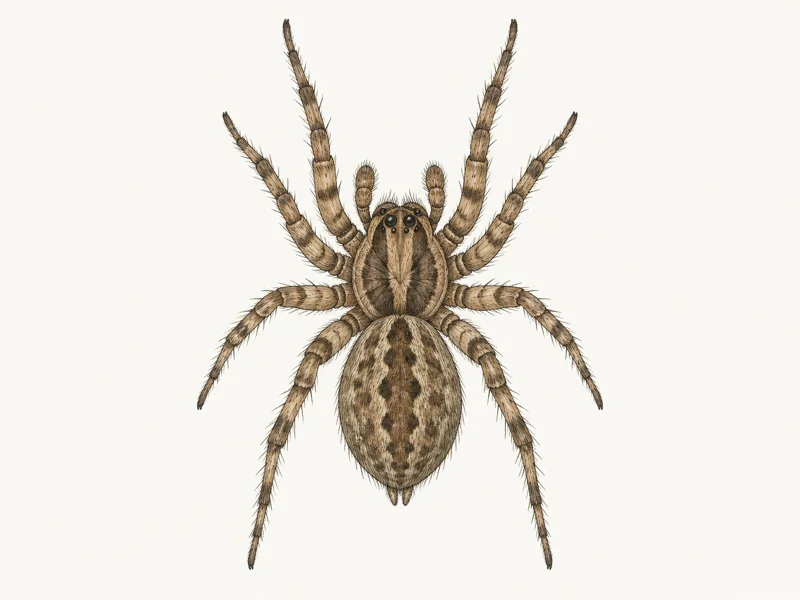
Annotated Anatomy Key (Wolf Spider)
- Large front eyes: Eight eyes in 3 distinct rows (two very large middle eyes reflect flashlight beams at night).
- Striped cephalothorax: Robust front carapace marked with twin dark lengthwise stripes—no recluse violin mark.
- Eight stout hairy legs: Four pairs of strong, spiny, mottled hunting legs built for chasing prey without webs.
- Mottled oval abdomen: Patterned brown-and-tan abdomen; females carry round egg sacs attached to spinnerets.
Wolf Spiders Field Checklist
- Stout, hairy brown-and-gray striped spider with prominent spiny legs
- Two notably large forward-facing eyes above a row of four tiny eyes (reflects flashlight beams at night)
- Hunts actively on the ground without spinning prey-catching webs
- Females uniquely carry round silk egg sacs on their spinnerets and piggyback spiderlings
Wolf Spiders Size at True Relative Scale
Quick Answer: Yes, wolf spiders (family Lycosidae) are common in New Hampshire, with 491 verified GBIF sightings statewide. They are ground-dwelling hunters that rate as a nuisance, not a danger, and they peak in April, May, June, and September. Sealing gaps, reducing clutter, and managing moisture keep them outdoors.
Where Wolf Spiders Live in New Hampshire
Are there wolf spiders in New Hampshire? Absolutely. GBIF records show the most sightings in Grafton, Hillsborough, Merrimack, Cheshire, and Rockingham counties. The state's forested terrain, with warm summers and cold, snowy winters (USDA zones 3b-6a), suits these spiders well.
Three species appear in the recorded sightings:
- Drumming Sword Wolf Spider (Gladicosa gulosa)
- Forest Wolf Spider (Hogna frondicola)
- Wetland Giant Wolf Spider (Tigrosa helluo)
Wolf spiders do not build webs to catch prey. They hunt on the ground, so look for them in leaf litter, under logs and stones, along woodpile edges, in garden beds, and near wetland margins. Some dig shallow burrows or shelter beneath debris.
When Wolf Spiders Are Most Active in New Hampshire
The New Hampshire wolf spider season centers on spring and early fall. GBIF sightings peak in April, May, June, and September. Spring activity is tied to warming ground and mating, while September brings young and adult spiders wandering as nights cool.
Females carry a round, silken egg sac attached to the spinnerets, and after hatching the spiderlings ride on her abdomen. Seeing this is a reliable sign you have a wolf spider. Most activity happens at night, and spiders that wander indoors in fall are often looking for shelter before winter.
New Hampshire Wolf Spider Identification
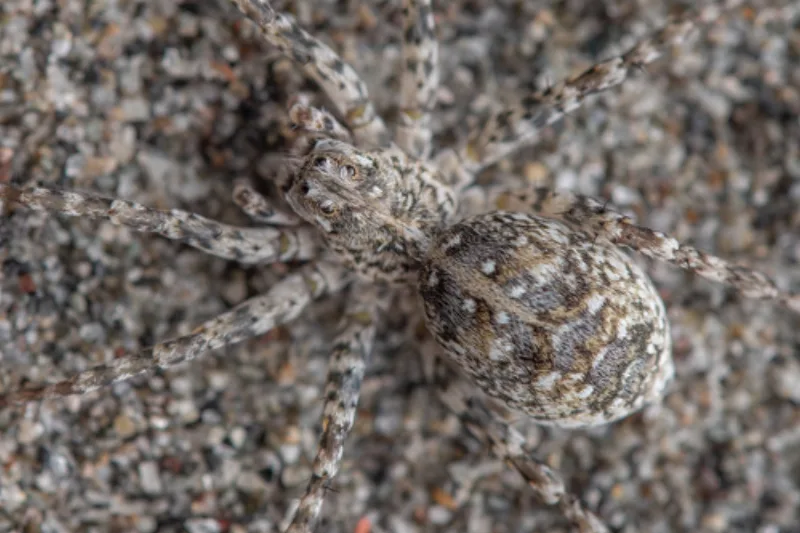
Wolf spiders are robust and hairy, usually brown, tan, or gray with darker stripes or mottling. Most adults are roughly half an inch to over an inch in body length, and they run fast across the ground.
- Eye pattern: eight eyes in three rows, with two large forward-facing eyes in the middle row and two smaller eyes below them in the bottom row.
- Body shape: sturdy, with thick, spiny legs built for running.
- Behavior: roams openly instead of sitting in a web.
Their eyes shine in a flashlight beam at night, a handy trick for spotting them on lawns.
Look-Alikes Frequently Mistaken for Wolf Spiders
Several other New Hampshire spiders resemble wolf spiders at a glance. Checking the eyes, web use, and habits usually settles it.
- Nursery web spiders (Pisauridae): longer, slimmer legs, and the female carries her egg sac in her jaws rather than on her spinnerets.
- Funnel weavers (Agelenidae): similar brown coloring, but they build sheet webs with a funnel retreat, often in grass or around foundations.
- Fishing spiders (Dolomedes): larger and found near ponds and streams, with a different eye arrangement.
- Ground spiders and other brown hunters: smaller, with less hairy bodies and a different eye layout.
How to Keep Wolf Spiders Out of Your New Hampshire Home
Learning how to prevent wolf spiders in New Hampshire starts with non-chemical steps. These spiders follow prey and shelter, so cutting off both works better than spraying.
- Exclude: seal gaps around doors, windows, utility lines, and foundation cracks. Install door sweeps and repair torn screens.
- Reduce harborage: move woodpiles, stones, and debris at least a few feet from the house. Rake leaf litter away from the foundation.
- Control moisture: fix leaks, direct downspouts away from the house, and run a dehumidifier in damp basements.
- Adjust lighting: outdoor lights attract the insects spiders eat. Use yellow bulbs or move fixtures away from entrances.
- Clean up indoors: vacuum spiders and egg sacs, and keep basements and garages free of clutter and stored cardboard.
- Use glue traps: place them along baseboards to monitor activity.
If you consider a pesticide, choose a product labeled for spiders and follow the EPA label exactly. Treat only where the label allows, and keep children and pets away.
When to Call a Licensed Pro
- You see spiders indoors repeatedly despite sealing and sanitation.
- Egg sacs or many spiderlings keep appearing inside walls, basements, or crawl spaces.
- You cannot identify a spider and want confirmation.
- Entry points are hard to reach or you need a product beyond over-the-counter options.
Wolf spiders may bite if handled or pressed against skin, but they are not considered medically significant. If you have a bite with a severe reaction, call US Poison Control at 1-800-222-1222 and contact a doctor.
IPM Prevention Checklist for New Hampshire Homes
- Install tight door sweeps and seal foundation gaps
- Keep firewood and thick mulch pulled back from siding
 EXCLUSION BLUEPRINT
Inspect eaves, screens, door sweeps, foundation cracks, and utility penetrations around New Hampshire homes before peak season.
Wolf Spiders in New Hampshire: Frequently Asked Questions
Are wolf spiders in New Hampshire dangerous?
No. They are classed as a nuisance and usually bite only when handled or trapped. Anyone with a worrying reaction should call Poison Control at 1-800-222-1222 and see a doctor.
Which wolf spider species occur in New Hampshire?
GBIF records include the Drumming Sword Wolf Spider (Gladicosa gulosa), Forest Wolf Spider (Hogna frondicola), and Wetland Giant Wolf Spider (Tigrosa helluo).
Why do I see wolf spiders in my house in fall?
September is a peak month. Cooling nights push wandering spiders toward sheltered spaces, and gaps near doors and foundations let them in.
Do wolf spiders build webs?
No. They hunt on the ground and use silk mainly for egg sacs and burrow linings. A funnel-shaped web in the grass usually belongs to a funnel weaver instead.
Sources & Verification
Data refreshed · Editorial & GBIF Methodology