Wolf Spiders in Louisiana: Identification, Season, and Prevention
Quick Answer: Yes, wolf spiders (family Lycosidae) are common in Louisiana, with 1,111 verified GBIF sightings statewide. They are ground-hunting nuisance spiders that peak from April through July. Sealing entry points, reducing clutter, and controlling moisture keep most out of the house.
When Wolf Spiders Are Most Active in Louisiana
Now (November): Lower Outdoor ActivityVerified Louisiana Counties, Species & US Range
Counties with Verified Observations
- East Baton Rouge
- Saint Tammany
- Tangipahoa
- Caddo
- Ouachita
- Plaquemines
- Lafourche
- Natchitoches
- Evangeline
- Orleans
Species Recorded in Louisiana
| Species | Scientific Name | GBIF Records |
|---|---|---|
| Georgia Wolf Spider | Tigrosa georgicola | 307 |
| Tigrosa annexa | Tigrosa annexa | 288 |
| Rabid Wolf Spider | Rabidosa rabida | 234 |
How Louisiana Compares to Neighboring States
Note: Wildlife does not follow state or county lines. GBIF totals reflect verified citizen and museum records, so low counts in a neighboring county do not guarantee absence.
How to Identify Wolf Spiders
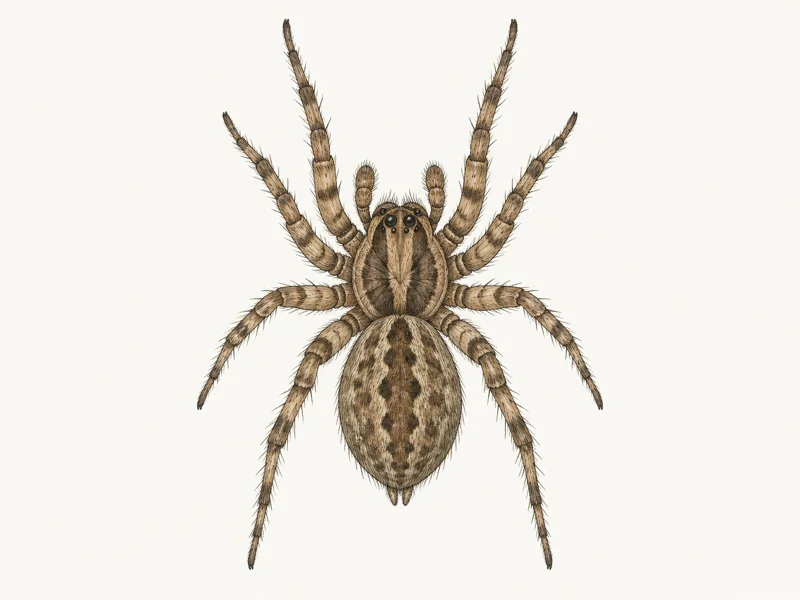
Annotated Anatomy Key (Wolf Spider)
- Large front eyes: Eight eyes in 3 distinct rows (two very large middle eyes reflect flashlight beams at night).
- Striped cephalothorax: Robust front carapace marked with twin dark lengthwise stripes—no recluse violin mark.
- Eight stout hairy legs: Four pairs of strong, spiny, mottled hunting legs built for chasing prey without webs.
- Mottled oval abdomen: Patterned brown-and-tan abdomen; females carry round egg sacs attached to spinnerets.
Wolf Spiders Field Checklist
- Stout, hairy brown-and-gray striped spider with prominent spiny legs
- Two notably large forward-facing eyes above a row of four tiny eyes (reflects flashlight beams at night)
- Hunts actively on the ground without spinning prey-catching webs
- Females uniquely carry round silk egg sacs on their spinnerets and piggyback spiderlings
Wolf Spiders Size at True Relative Scale
Quick Answer: Yes, wolf spiders (family Lycosidae) are common in Louisiana, with 1,111 verified GBIF sightings statewide. They are ground-hunting nuisance spiders that peak from April through July. Sealing entry points, reducing clutter, and controlling moisture keep most out of the house.
Where Wolf Spiders Live in Louisiana
Anyone asking whether there are wolf spiders in Louisiana can rest assured the answer is yes. GBIF records cluster in East Baton Rouge, Saint Tammany, Tangipahoa, Caddo, and Ouachita parishes, though the spiders occur across the state. Louisiana's humid subtropical climate (USDA zones 8a-10a), with hot, very wet summers and mild, frost-light winters, suits them well.
Recorded species include the Georgia wolf spider (Tigrosa georgicola), Tigrosa annexa, and the rabid wolf spider (Rabidosa rabida). Despite its name, the rabid wolf spider is not linked to rabies.
Typical Habitats
- Lawns, leaf litter, mulch beds, and wood piles
- Burrows or silk-lined retreats under rocks and logs
- Garages, sheds, porches, and door thresholds
- Edges of fields, pine woods, and wetland margins
Wolf spiders do not build webs to catch prey. They hunt on the ground, mostly at night, and often wander indoors by accident.
When Wolf Spiders Are Most Active in Louisiana
Louisiana wolf spider season peaks in April, May, June, and July, based on GBIF sighting dates. Warm, humid weather boosts hunting and mating, so males roam widely and turn up in garages and living areas. Sightings continue at lower levels through much of the year because winters are mild.
Females carry a round, silken egg sac attached to their spinnerets. After hatching, the spiderlings ride on the mother's back, a trait that helps with identification.
Louisiana Wolf Spider Identification
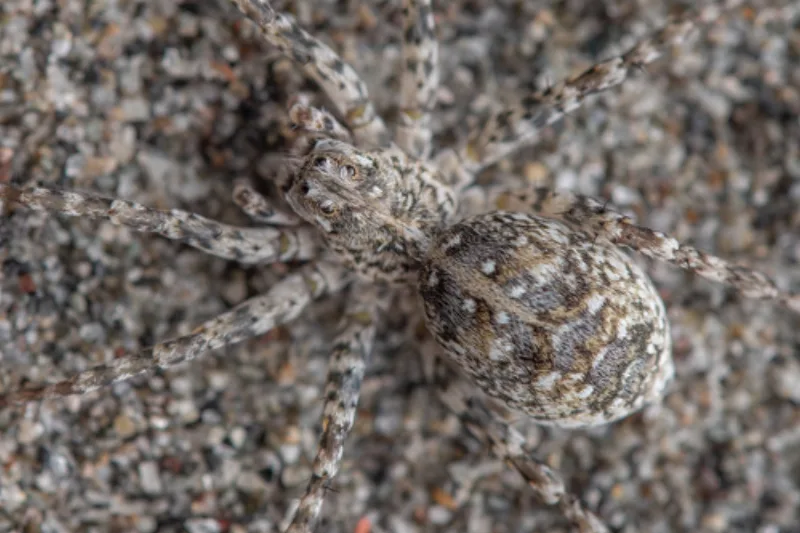
Wolf spiders are hairy, robust, and typically brown, gray, or tan with darker stripes or mottling. Most adults measure roughly half an inch to over an inch in body length. Their legs are sturdy and built for running.
- Eye arrangement: eight eyes in three rows, with two large eyes facing forward on top of the head and two medium eyes below a row of four smaller ones.
- Behavior: fast runners that hunt rather than sit in a web.
- Eyeshine: eyes reflect a flashlight beam at night.
Look-Alikes Frequently Mistaken for Wolf Spiders
Several Louisiana spiders get confused with wolf spiders. Checking the eyes and body shape usually settles it.
- Brown recluse spiders: uniformly tan to brown with only six eyes in three pairs and a violin-shaped marking. They have no leg stripes and are not hairy. Brown recluses are medically significant, so suspected bites warrant a call to US Poison Control (1-800-222-1222) and a doctor.
- Tarantulas: larger and heavier-bodied with thick, hairy legs. They are not typical house guests in Louisiana, so a large hairy spider outdoors is far more likely a wolf spider.
- Other ground and house spiders: many brownish spiders resemble wolf spiders at a glance, but most lack the distinctive eye pattern.
Wolf spiders may bite if pressed against skin, but they are not considered dangerous to most people. Wash the area, and seek medical advice if symptoms worsen or an allergic reaction is suspected. Do not try home remedies for venom.
How to Keep Wolf Spiders Out of Your Louisiana Home
Learning how to prevent wolf spiders in Louisiana starts with non-chemical Integrated Pest Management (IPM). Extension entomology guidance consistently stresses exclusion, sanitation, and moisture control before any pesticide.
Non-Chemical Steps First
- Install door sweeps and repair torn window and door screens.
- Seal gaps around pipes, utility lines, and foundation cracks with caulk.
- Move firewood, mulch, and debris at least a foot or more from the foundation.
- Trim vegetation and keep grass mowed near the house.
- Fix leaks, run dehumidifiers, and ventilate crawl spaces and garages.
- Reduce outdoor lighting near doors, since lights attract the insects spiders eat.
- Declutter storage areas and use sticky traps to monitor activity.
Chemicals and Professional Help
If you use any insecticide, choose a product labeled for spiders and follow the EPA-approved label exactly. Use it sparingly, since wolf spiders also eat roaches, crickets, and other pests.
Call a licensed Louisiana pest professional if you notice:
- Frequent wolf spiders indoors despite exclusion work
- Signs of heavy insect infestations feeding the spiders
- Uncertainty whether a spider is a brown recluse
- Spiders in places where children or allergy-prone people are at risk
IPM Prevention Checklist for Louisiana Homes
- Install tight door sweeps and seal foundation gaps
- Keep firewood and thick mulch pulled back from siding
 EXCLUSION BLUEPRINT
Inspect eaves, screens, door sweeps, foundation cracks, and utility penetrations around Louisiana homes before peak season.
Wolf Spiders in Louisiana: Frequently Asked Questions
Are there wolf spiders in Louisiana?
Yes. Wolf spiders are common statewide, with GBIF records of the Georgia wolf spider, Tigrosa annexa, and the rabid wolf spider.
Are Louisiana wolf spiders dangerous?
They are considered nuisance spiders. A bite can be painful but is rarely serious. For concerning symptoms, contact US Poison Control at 1-800-222-1222 or a doctor.
When are wolf spiders most common in Louisiana?
Sightings peak from April through July, when warm, humid conditions drive hunting and mating activity.
How can I tell a wolf spider from a brown recluse?
Wolf spiders have eight eyes, including two large ones, plus striped, hairy bodies. Brown recluses have six eyes in pairs and a smooth, uniform look.
Sources & Verification
Data refreshed · Editorial & GBIF Methodology