Spider vs Wolf Spider: How to Tell Them Apart Fast
Quick ID Verdict: Every wolf spider is a spider, but most spiders are not wolf spiders. If the spider is stout, hairy, and striped in brown and gray, with prominent spiny legs, and it is running across the floor instead of sitting in a web, it is almost certainly a wolf spider (family Lycosidae).
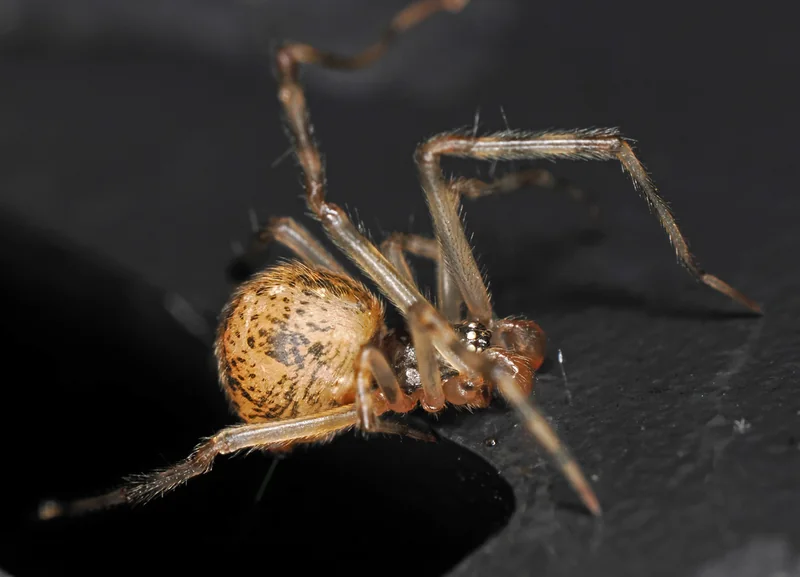
Spider
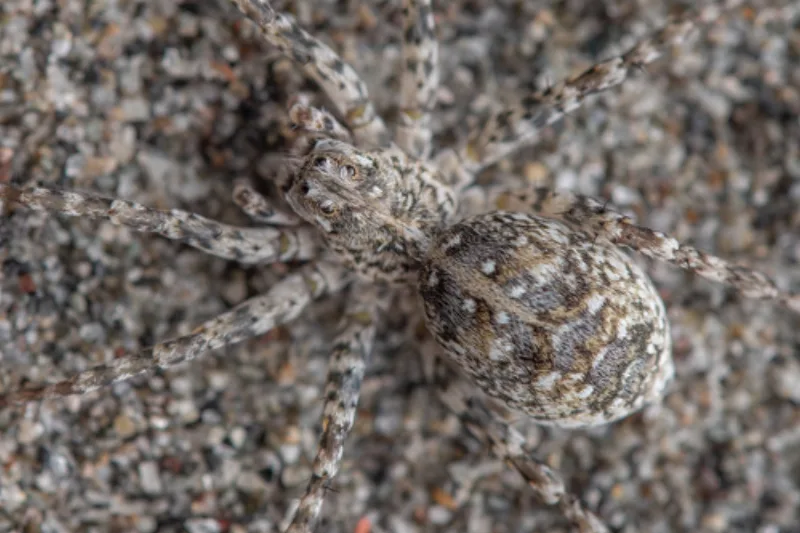
Wolf Spider
Side-by-Side Comparison Table
| Trait | Spider | Wolf Spider |
|---|---|---|
| Scientific Group | Araneae | Lycosidae |
| Category | Spider | Spider |
| Typical Size | 3–80 mm | 10–35 mm |
| Danger Level | Nuisance | Nuisance |
| Bites or Stings? | Yes | Yes |
| Peak US Months | June, July, August, September | May, June, July, August |
| Key ID Trait | Two main body segments (cephalothorax and abdomen) and eight jointed legs | Stout, hairy brown-and-gray striped spider with prominent spiny legs |
Spider vs. Wolf Spider: True Size Comparison
Side-by-Side Anatomy Blueprint
Compare body segments, antennae, leg count, and key markings directly before treating or removing either species.
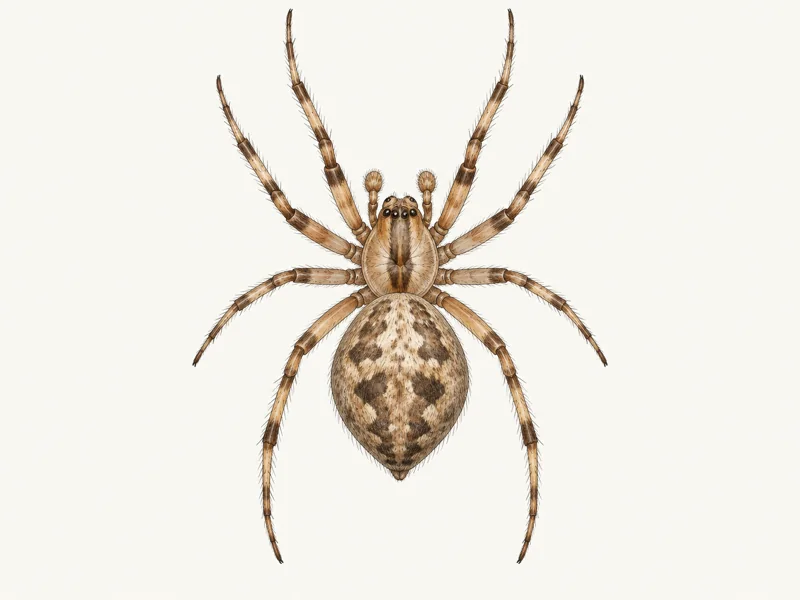
- Eight tiny eyes: Two curved rows of 8 small eyes on a smooth tan front cephalothorax.
- Banded slender legs: Eight long thin tan legs ringed with darker brown bands at the joints.
- Comb-footed hind legs: Fine bristles on hind legs help fling silk over trapped insects in cobwebs.
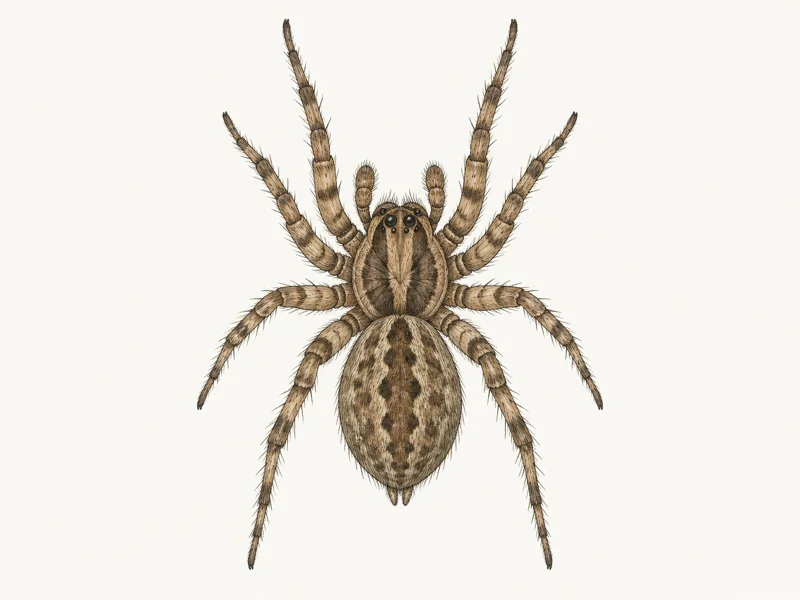
- Large front eyes: Eight eyes in 3 distinct rows (two very large middle eyes reflect flashlight beams at night).
- Striped cephalothorax: Robust front carapace marked with twin dark lengthwise stripes—no recluse violin mark.
- Eight stout hairy legs: Four pairs of strong, spiny, mottled hunting legs built for chasing prey without webs.
Quick Answer: Every wolf spider is a spider, but most spiders are not wolf spiders. If the spider is stout, hairy, and striped in brown and gray, with prominent spiny legs, and it is running across the floor instead of sitting in a web, it is almost certainly a wolf spider (family Lycosidae). Any other eight-legged animal with two main body segments belongs to the broader spider order, Araneae.
Both groups are rated as nuisance pests, not serious threats. Telling them apart helps homeowners pick the right prevention strategy.
Key Visual & Physical Differences
The main difference between a spider and a wolf spider is scope. "Spider" covers the entire order Araneae, a group with thousands of species in North America alone. Wolf spiders are one family within that order, and they have a distinct, recognizable build.
Spiders (Order Araneae)
- Size: 3 to 80 mm, which runs from tiny house spiders to large tarantulas.
- Key ID: Two main body segments, the cephalothorax and the abdomen, plus eight jointed legs.
- Appearance: Very wide variation in color, shape, and hairiness. Many are slender, glossy, or brightly patterned.
- Webs: Many species build visible webs in corners, windows, and eaves.
Wolf Spiders (Family Lycosidae)
- Size: 10 to 35 mm, so they are medium to large for a household spider.
- Key ID: A stout, hairy body with brown-and-gray stripes and prominent spiny legs.
- Eyes: A row of large, forward-facing eyes gives them sharp vision. A flashlight held at eye level often makes the eyes shine back at night.
- Webs: They do not use webs to catch prey.
3-Second Field Check
For quick spider vs wolf spider identification, look at three things: body shape, color pattern, and whether there is a web. A thick, fuzzy, striped spider moving fast on the ground points to a wolf spider. A spider resting in a web, or one with a slim or shiny body, is almost always some other kind of spider.
Behavior, Habitat & Danger Comparison
Hunting Style
Many common household spiders are web builders. They wait in corners, basements, and window frames for insects to fly or walk into their silk. Wolf spiders hunt actively. They chase down crickets, beetles, and other ground insects using speed and eyesight.
Where They Live
General spiders live almost everywhere, including attics, closets, garages, gardens, and shrubs. Wolf spiders mostly live on the ground in leaf litter, mulch, turf, woodpiles, and under stones. They usually come indoors by accident and are often seen near doors, along baseboards, or in basements and garages.
Distinctive Habits
- Female wolf spiders carry their egg sacs attached to the spinnerets.
- After hatching, the spiderlings ride on the mother's back for a short time.
- Web-building spiders tend to stay in one place, while wolf spiders roam.
Danger Level
Both groups are classified as nuisance pests. Wolf spiders are not aggressive and usually bite only when handled or pressed against skin. Their bites are generally compared to a bee sting. A few spiders in the broader order, such as widows and recluses, are medically significant. That is why a correct ID matters.
If someone is bitten and has spreading redness, severe pain, muscle cramping, or trouble breathing, or if the spider can't be identified, call US Poison Control at 1-800-222-1222 and contact a doctor. Do not rely on home remedies.
Which One Is Worse for Homeowners?
Neither one is a major threat, but they cause different problems. General spiders tend to be the bigger cosmetic nuisance because their webs build up in corners, light fixtures, and eaves. Wolf spiders startle people more because of their size and speed, but they rarely settle or breed indoors.
Whether the visitor is a common spider or a wolf spider, Integrated Pest Management (IPM) should come first:
- Exclusion: Seal gaps around doors, windows, utility lines, and foundation cracks. Install door sweeps and repair torn screens.
- Sanitation: Vacuum webs, egg sacs, and spiders regularly. Reduce indoor clutter, especially cardboard boxes in basements and garages.
- Moisture control: Run dehumidifiers in damp basements and fix leaks. Dry spaces support fewer of the insects spiders eat.
- Yard care: Pull mulch, woodpiles, and leaf litter away from the foundation. Use yellow or sodium-vapor bulbs outdoors so lights attract fewer insects.
- Monitoring: Place sticky traps along baseboards to see where spiders are getting in.
If chemical control is still needed, choose products labeled for spiders and follow the EPA product label exactly. Treat perimeter entry points rather than broadcasting indoors. For recurring problems or suspected medically significant species, call a licensed pest professional.
Frequently Asked Questions
Is a wolf spider just a type of spider?
Yes. Wolf spiders belong to the family Lycosidae within the spider order Araneae. Every wolf spider is a spider, but not every spider is a wolf spider.
How big do wolf spiders get compared to other spiders?
Wolf spiders measure 10 to 35 mm. Spiders as a whole range from 3 to 80 mm, so wolf spiders fall in the middle of that range.
Do wolf spiders build webs?
No, they don't use webs to catch prey. They hunt on the ground, which is one of the easiest ways to tell whether you're looking at a common spider or a wolf spider.
Are wolf spiders dangerous to pets or people?
They are considered nuisance pests and rarely bite unless handled. If a person or pet has a severe reaction, call Poison Control at 1-800-222-1222 or a veterinarian right away.