Brown Recluse in New Hampshire: Are They Here? Facts and Look-Alikes
Quick Answer: Breeding populations of brown recluse spiders (Loxosceles reclusa) do not occur in New Hampshire. The state sits well north of the species' native range, and a rare hitchhiker in a moving box or shipment would not start a colony. Nearly every "recluse" found in a Granite State home turns out to be a wolf spider, cellar spider, or another common house spider.
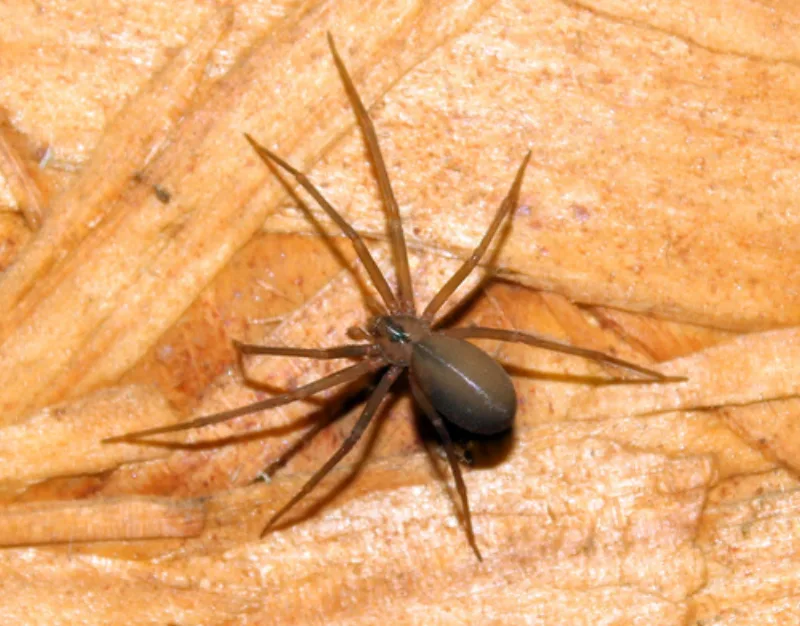
When Brown Recluse Spiders Are Most Active in New Hampshire
November: Rare / AbsentBrown Recluse Spiders Range in New Hampshire vs. Neighboring States
How New Hampshire Compares to Neighboring States
Note: Wildlife does not follow state or county lines. GBIF totals reflect verified citizen and museum records, so low counts in a neighboring county do not guarantee absence.
How to Identify Brown Recluse Spiders
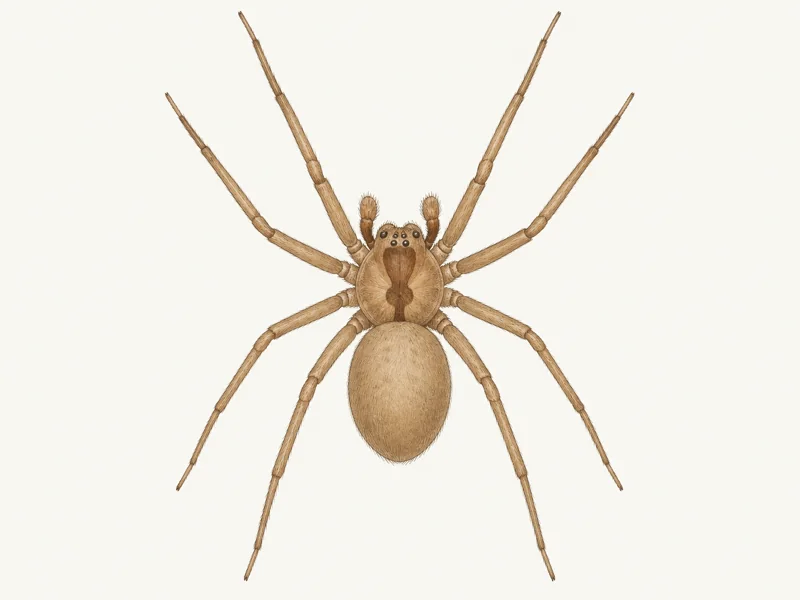
Annotated Anatomy Key (Brown Recluse)
- Six eyes (3 pairs): Six eyes arranged in 3 distinct dyads (pairs) rather than the typical 8 spider eyes.
- Dark violin mark: Dark brown violin-shaped mark on the cephalothorax—wide base behind eyes, thin neck pointing toward abdomen.
- Unbanded smooth legs: Eight uniformly tan-brown legs with NO stripes, rings, or heavy macro-spines.
- Velvety oval abdomen: Uniformly tan to medium brown abdomen covered in fine velvety hairs—no spots or chevrons.
Brown Recluse Spiders Field Checklist
- Uniformly tan to medium brown body with NO stripes, bands, or spines on the legs
- Dark violin-shaped mark on the cephalothorax (neck pointing toward abdomen)
- Six eyes arranged in three distinct pairs (dyads) rather than eight eyes
- Smooth, velvety fine hairs on abdomen; spins messy sheet-like retreat webs
Side-by-Side Look-Alike Comparisons
Brown Recluse Spiders Size at True Relative Scale
Where Brown Recluse Spiders Live in New Hampshire
They don't live here in any established way. GBIF occurrence records and university extension references place Loxosceles reclusa in the central and south-central US, and New Hampshire falls outside that range. So if you're asking whether there are brown recluse in New Hampshire, the answer is no, apart from very rare accidental transport.
The state has a humid continental climate with warm, forested summers and cold, snowy winters (USDA zones 3b to 6a). Those long freezing winters make it very hard for a heat-loving species to persist outdoors. An isolated hitchhiker could survive for a time inside a heated building, but that is an unusual event, not a local population.
- Established status: Not established in New Hampshire.
- Possible exception: A single spider arriving in furniture, boxes, or freight from farther south.
- Most likely explanation for a "sighting": A misidentified native spider.
When Brown Recluse Spiders Are Most Active in New Hampshire
There is no New Hampshire brown recluse season, because there is no local population to follow a seasonal cycle. In their native range, recluses are generally active in the warmer months and wander indoors at night. That pattern doesn't apply to the state.
What residents do notice is a seasonal spike in spider sightings. Wolf spiders are most visible in late summer and fall, when they wander in search of mates and shelter. Cellar spiders stay in basements and corners all year. Fall is also when many homeowners start seeing spiders indoors as temperatures drop.
Look-Alikes Frequently Mistaken for Brown Recluse Spiders
Accurate New Hampshire brown recluse identification starts with the features of the true species. A real recluse has a uniform tan to brown body, six eyes arranged in three pairs, and legs without spines or bands. The dark violin marking is not a reliable clue by itself, since many spiders have markings that look similar.
Wolf Spiders
Wolf spiders are hairy, brown, and fast, often with striped or mottled patterns. They have eight eyes, with two large ones prominent on the face. They hunt on the ground and frequently turn up in garages, basements, and along door thresholds.
Cellar Spiders
Cellar spiders, often called daddy longlegs, have very long, thin legs and small pale bodies. They hang upside down in loose, messy webs in basements, crawl spaces, and corners. Their build is quite different from a recluse's.
Other Common House Spiders
Many other brownish house spiders are also reported as recluses. Check for leg spines, banded legs, or a patterned abdomen. Any of these rules out a brown recluse.
If you are unsure, photograph the spider next to a ruler, or capture it in a jar and take it to your local UNH Cooperative Extension office or another qualified identifier.
How to Keep Brown Recluse Spiders Out of Your New Hampshire Home
Learning how to prevent brown recluse in New Hampshire really means preventing spiders in general, and non-chemical steps come first. These methods also reduce wolf spiders and other house spiders.
- Exclusion: Seal gaps around doors, windows, utility lines, and foundation cracks. Add door sweeps and repair damaged screens.
- Sanitation: Vacuum corners, baseboards, and webs regularly. Reduce clutter in basements, garages, and closets.
- Storage: Use sealed plastic bins instead of cardboard boxes, especially for items shipped or moved from southern states.
- Moisture control: Run a dehumidifier in damp basements and fix leaks, since moisture draws the insects spiders eat.
- Outdoors: Move firewood, leaf piles, and debris away from the foundation. Switch to yellow or sodium bulbs near entrances to draw fewer insects.
- Monitoring: Place sticky traps along walls to see what is actually present.
If you use any insecticide, choose a product labeled for the site and pest, and follow the EPA-approved label directions exactly.
When to Call a Licensed New Hampshire Pest Professional
- You see many spiders despite sealing and cleaning.
- You have captured a specimen that an expert says may be a recluse.
- You are dealing with a heavy insect problem that is feeding spiders.
- You cannot reach or safely treat crawl spaces, attics, or wall voids.
Bites and Safety
This guide is not medical advice. If a spider bite causes severe symptoms, or you are worried about a reaction, call US Poison Control at 1-800-222-1222 and contact a doctor. Do not try home remedies.
IPM Prevention Checklist for New Hampshire Homes
- Replace cardboard storage with sealed plastic totes
- Keep bed skirts off the floor and pull beds away from walls
- Shake out shoes, towels, and stored clothing before wearing
 EXCLUSION BLUEPRINT
Inspect eaves, screens, door sweeps, foundation cracks, and utility penetrations around New Hampshire homes before peak season.
Brown Recluse Spiders in New Hampshire: Frequently Asked Questions
Are there brown recluse in New Hampshire?
No established populations exist in the state. A rare individual might arrive in cargo or household goods, but that does not create a colony.
What spider in New Hampshire looks like a brown recluse?
Wolf spiders and cellar spiders are the most common mix-ups, along with other brownish house spiders. Look for leg spines, banded legs, and eight eyes, which rule out a recluse.
Can a brown recluse survive a New Hampshire winter?
Outdoors, very unlikely. A stray spider could live for a while inside a heated building, but it would not form a lasting population.
What should I do if I think I found one?
Photograph or capture it and have it identified through UNH Cooperative Extension or a licensed pest professional. For bite concerns, call Poison Control at 1-800-222-1222 and see a doctor.
Sources & Verification
- UC Riverside Spider Biology — Brown Recluse Range & Myths
- University of Kentucky Entomology — Brown Recluse Spider
- GBIF Global Biodiversity Occurrence Records
Data refreshed · Editorial & GBIF Methodology