Brown Recluse in North Carolina: Facts, Look-Alikes and Prevention
Quick Answer: Breeding populations of the brown recluse spider (Loxosceles reclusa) are not established in North Carolina. Rare individuals can arrive as accidental hitchhikers in boxes, furniture, or vehicles from states where the species is native.
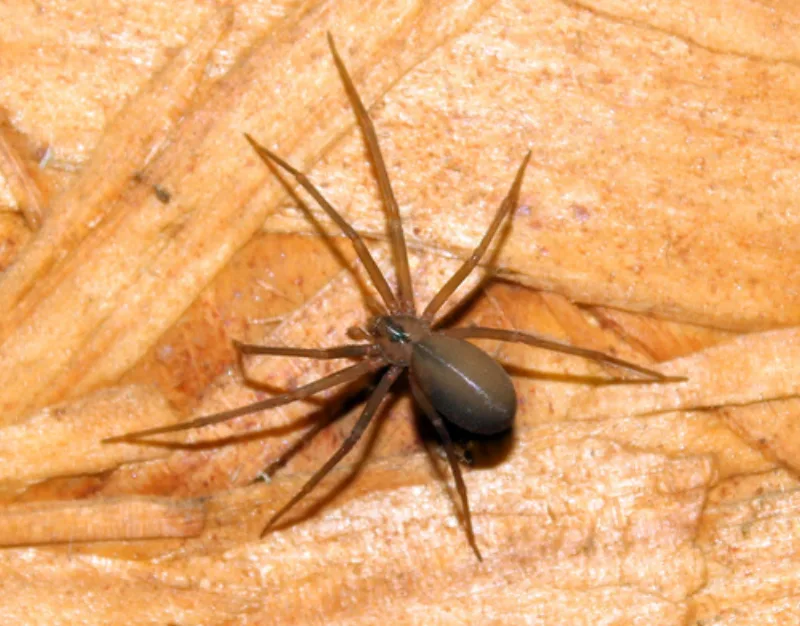
When Brown Recluse Spiders Are Most Active in North Carolina
Now (November): Lower Outdoor ActivityVerified North Carolina Counties, Species & US Range
Counties with Verified Observations
- Rockingham
- Wake
- Haywood
- Stokes
- Guilford
- Henry
- Swain
- Davidson
- Hoke
- Cabarrus
Species Recorded in North Carolina
| Species | Scientific Name | GBIF Records |
|---|---|---|
| brown recluse | Loxosceles reclusa | 27 |
How North Carolina Compares to Neighboring States
Note: Wildlife does not follow state or county lines. GBIF totals reflect verified citizen and museum records, so low counts in a neighboring county do not guarantee absence.
How to Identify Brown Recluse Spiders
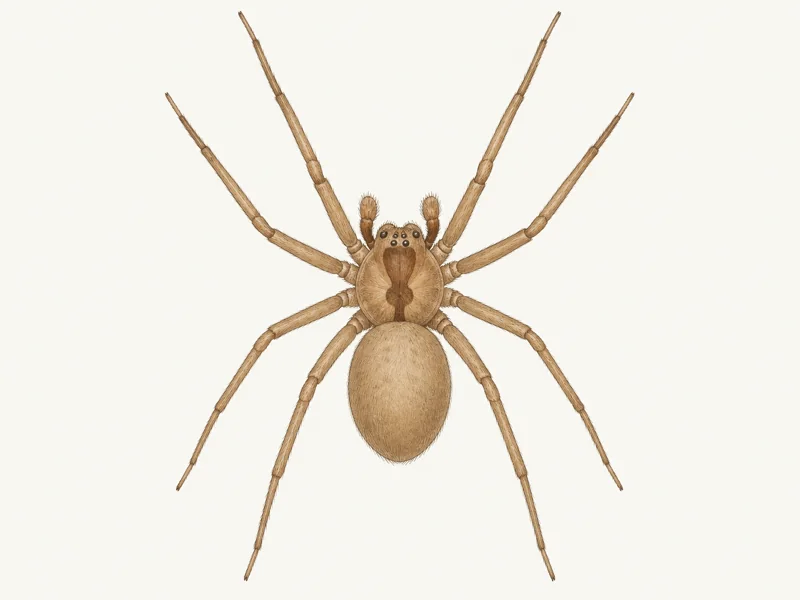
Annotated Anatomy Key (Brown Recluse)
- Six eyes (3 pairs): Six eyes arranged in 3 distinct dyads (pairs) rather than the typical 8 spider eyes.
- Dark violin mark: Dark brown violin-shaped mark on the cephalothorax—wide base behind eyes, thin neck pointing toward abdomen.
- Unbanded smooth legs: Eight uniformly tan-brown legs with NO stripes, rings, or heavy macro-spines.
- Velvety oval abdomen: Uniformly tan to medium brown abdomen covered in fine velvety hairs—no spots or chevrons.
Brown Recluse Spiders Field Checklist
- Uniformly tan to medium brown body with NO stripes, bands, or spines on the legs
- Dark violin-shaped mark on the cephalothorax (neck pointing toward abdomen)
- Six eyes arranged in three distinct pairs (dyads) rather than eight eyes
- Smooth, velvety fine hairs on abdomen; spins messy sheet-like retreat webs
Side-by-Side Look-Alike Comparisons
Brown Recluse Spiders Size at True Relative Scale
Quick Answer: Breeding populations of the brown recluse spider (Loxosceles reclusa) are not established in North Carolina. Rare individuals can arrive as accidental hitchhikers in boxes, furniture, or vehicles from states where the species is native. Most spiders reported as a brown recluse in North Carolina turn out to be wolf spiders, cellar spiders, or other common brown spiders.
Where Brown Recluse Spiders Live in North Carolina
People often ask, "Are there brown recluse in North Carolina?" The short answer is no self-sustaining populations. The species' native range is centered in the south-central Midwest, and GBIF occurrence records do not support an established population anywhere in the state, from the coastal plain through the piedmont to the Blue Ridge mountains.
Occasional single finds do happen. These spiders are tied to shipments, moving trucks, stored goods, or used furniture brought from established regions. One spider found in a garage or attic does not mean an infestation is present.
- Most likely sources: moving boxes, antiques, secondhand furniture, and stored items from out of state.
- Most likely locations: undisturbed storage areas, closets, basements, and garages.
- Not expected: outdoor breeding populations in North Carolina woods, yards, or gardens.
When Brown Recluse Spiders Are Most Active in North Carolina
Because the species is not established, there is no true North Carolina brown recluse season. A hitchhiking spider can turn up any time of year, usually soon after a move or a delivery of stored goods.
What residents do notice is seasonal activity from local spiders. Wolf spiders become more visible in late summer and fall as they wander in search of mates or shelter, and cellar spiders stay active indoors year-round. The state's humid subtropical climate across much of the coastal plain and piedmont keeps many spiders active for long stretches, while the cooler mountains see a shorter outdoor season.
Look-Alikes Frequently Mistaken for Brown Recluse Spiders
Accurate North Carolina brown recluse identification starts with a few key traits. A true brown recluse is uniformly tan to brown, has a dark violin-shaped mark on the front body section with the neck pointing toward the abdomen, has no stripes or bands on its legs, and has six eyes arranged in three pairs. Most spiders have eight eyes, so eye arrangement is one of the most reliable checks.
Wolf Spiders
Wolf spiders are the most common source of mistaken reports. They are hairy, often larger and bulkier than a recluse, and typically show striped or mottled patterns. They also have eight eyes, with two large eyes that reflect light at night.
Cellar Spiders
Cellar spiders, sometimes called daddy longlegs spiders, live in basements and crawl spaces. Their very long, thin legs and small, pale bodies set them apart, and they hang upside down in loose, messy webs rather than hiding in clutter.
Other Common Brown Spiders
Many harmless brown spiders, including funnel weavers, sac spiders, and grass spiders, share a similar color. Banded legs, patterned abdomens, or eight eyes rule out a brown recluse. If unsure, a clear photo or a preserved specimen can be submitted to a county Cooperative Extension office for identification.
How to Keep Brown Recluse Spiders Out of Your North Carolina Home
Learning how to prevent brown recluse in North Carolina homes is mostly about stopping hitchhikers and reducing habitat for all spiders. Integrated Pest Management (IPM) guidance from university cooperative extension programs favors non-chemical steps first.
- Inspect incoming items: Check boxes, furniture, and stored goods from out of state before bringing them inside, ideally outdoors or in a garage.
- Use sealed containers: Swap cardboard boxes for plastic bins with tight lids in attics, closets, and basements.
- Reduce clutter: Remove piles of clothing, paper, and stored items that offer hiding spots.
- Seal entry points: Caulk gaps, repair window screens, and add door sweeps.
- Control moisture: Use dehumidifiers in crawl spaces and fix leaks, which reduces the insects spiders feed on.
- Use sticky traps: Place glue traps along walls and behind furniture to monitor what is actually present.
Pesticides are rarely needed for occasional spiders. If any product is used, follow the EPA product label exactly, since the label is the law.
When to Call a Licensed North Carolina Pest Professional
- A spider has been confirmed as a brown recluse by an expert.
- Multiple spiders with recluse traits appear on sticky traps over several weeks.
- Shed skins or egg sacs are found in stored items brought from another state.
- Spider activity continues despite exclusion and decluttering.
Choose a pest control operator licensed by the North Carolina Department of Agriculture and Consumer Services.
Bite safety: This guide does not provide medical advice. If a spider bite is suspected, call US Poison Control at 1-800-222-1222 and contact a doctor. Many skin wounds blamed on spiders have other causes, so a medical evaluation is important.
IPM Prevention Checklist for North Carolina Homes
- Replace cardboard storage with sealed plastic totes
- Keep bed skirts off the floor and pull beds away from walls
- Shake out shoes, towels, and stored clothing before wearing
 EXCLUSION BLUEPRINT
Inspect eaves, screens, door sweeps, foundation cracks, and utility penetrations around North Carolina homes before peak season.
Brown Recluse Spiders in North Carolina: Frequently Asked Questions
Are brown recluse spiders native to North Carolina?
No. The brown recluse is not established in North Carolina. Rare individuals arrive as hitchhikers in goods or furniture from states where the species is native.
What spider is most often mistaken for a brown recluse in North Carolina?
Wolf spiders are the most common mix-up, followed by cellar spiders and other brown house spiders. Checking for six eyes and plain, unbanded legs helps rule out look-alikes.
What should someone do if they find a suspected brown recluse?
Capture it in a sealed jar or photograph it clearly, then submit it to a county Cooperative Extension office for identification. Inspect nearby stored items and set sticky traps to check for more.
Who should be called after a suspected spider bite?
Call US Poison Control at 1-800-222-1222 and see a doctor. Avoid home remedies and do not rely on self-diagnosis.
Sources & Verification
- UC Riverside Spider Biology — Brown Recluse Range & Myths
- University of Kentucky Entomology — Brown Recluse Spider
- GBIF Global Biodiversity Occurrence Records
Data refreshed · Editorial & GBIF Methodology