Brown Recluse in South Dakota: Are They Here? Facts and Look-Alikes
Quick Answer: Breeding populations of brown recluse spiders (Loxosceles reclusa) do not occur in South Dakota. The state lies outside the species' established range, and the spiders most residents suspect are common look-alikes such as wolf spiders and cellar spiders. Only rare accidental hitchhikers in moved boxes or furniture are plausible.
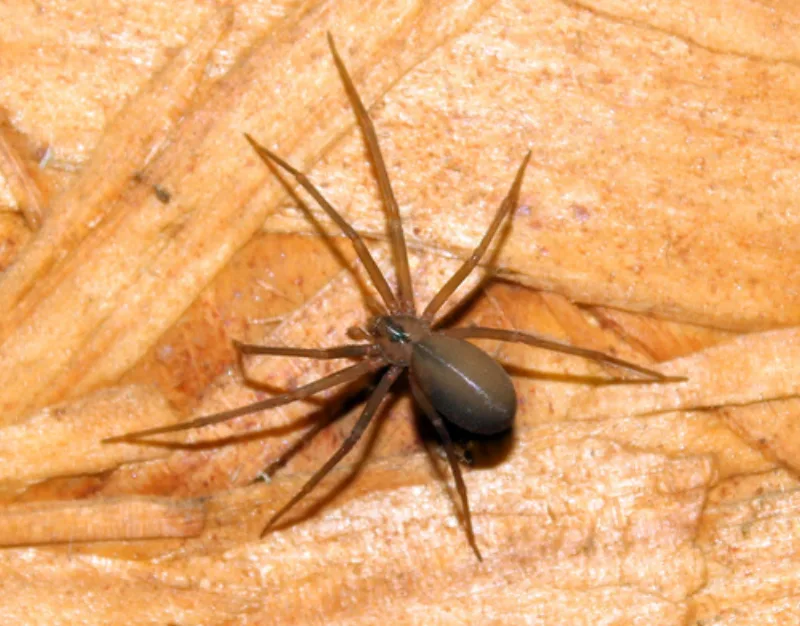
When Brown Recluse Spiders Are Most Active in South Dakota
Now (November): Lower Outdoor ActivityVerified South Dakota Counties, Species & US Range
Counties with Verified Observations
- Union
Species Recorded in South Dakota
| Species | Scientific Name | GBIF Records |
|---|---|---|
| brown recluse | Loxosceles reclusa | 1 |
How South Dakota Compares to Neighboring States
Note: Wildlife does not follow state or county lines. GBIF totals reflect verified citizen and museum records, so low counts in a neighboring county do not guarantee absence.
How to Identify Brown Recluse Spiders
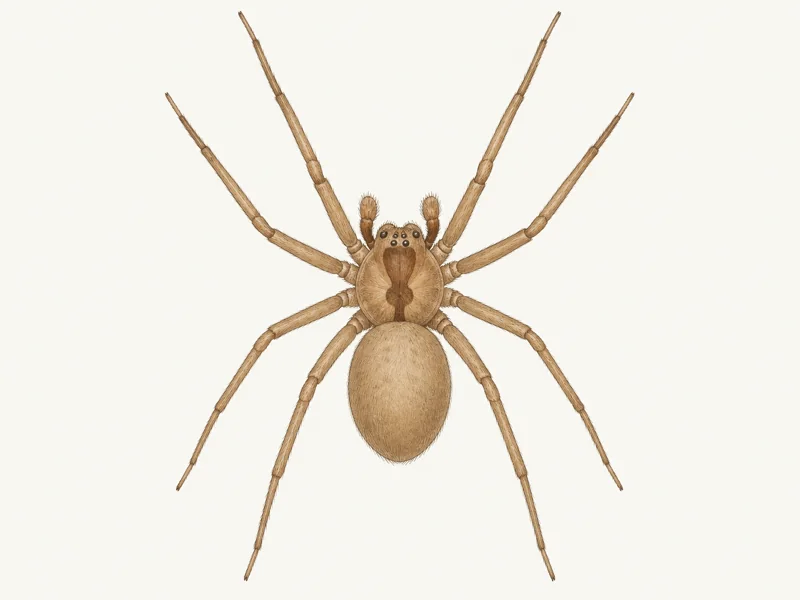
Annotated Anatomy Key (Brown Recluse)
- Six eyes (3 pairs): Six eyes arranged in 3 distinct dyads (pairs) rather than the typical 8 spider eyes.
- Dark violin mark: Dark brown violin-shaped mark on the cephalothorax—wide base behind eyes, thin neck pointing toward abdomen.
- Unbanded smooth legs: Eight uniformly tan-brown legs with NO stripes, rings, or heavy macro-spines.
- Velvety oval abdomen: Uniformly tan to medium brown abdomen covered in fine velvety hairs—no spots or chevrons.
Brown Recluse Spiders Field Checklist
- Uniformly tan to medium brown body with NO stripes, bands, or spines on the legs
- Dark violin-shaped mark on the cephalothorax (neck pointing toward abdomen)
- Six eyes arranged in three distinct pairs (dyads) rather than eight eyes
- Smooth, velvety fine hairs on abdomen; spins messy sheet-like retreat webs
Side-by-Side Look-Alike Comparisons
Brown Recluse Spiders Size at True Relative Scale
Where Brown Recluse Spiders Live in South Dakota
They don't, at least not as an established species. GBIF occurrence records and university extension guidance place the brown recluse's native range in the south-central and Midwestern United States, well south and southeast of the Dakotas. South Dakota's continental plains climate, with hot summers, cold windy winters, and USDA zones 4a to 5b, sits beyond that range.
So the answer to "are there brown recluse in South Dakota" is no, not as a resident, breeding species. An isolated spider may occasionally arrive in cargo, household goods, or vehicles from farther south. A single transported spider does not mean a local population exists.
When Brown Recluse Spiders Are Most Active in South Dakota
There is no South Dakota brown recluse season, because there is no established population to follow through the year. Where the species is established, activity generally rises in warm months and slows in cold weather, but that pattern does not describe South Dakota.
What residents do see are native spiders that move indoors in late summer and fall as nights cool. Wolf spiders in particular wander into garages and basements then. Cellar spiders persist indoors year-round in damp, undisturbed spaces.
Look-Alikes Frequently Mistaken for Brown Recluse Spiders
South Dakota brown recluse identification starts with ruling out common local spiders. Many are brown, and many people notice a violin-like shape that isn't there. Color alone is not a reliable clue.
Wolf Spiders
- Robust, hairy, brown with darker stripes or mottling.
- Run quickly across the ground, often at night, and hunt rather than build webs.
- Eight eyes in three rows, with two notably large eyes.
Cellar Spiders
- Very long, thin legs and a small pale tan or gray body.
- Hang upside down in loose, messy webs in basements, crawl spaces, and corners.
- Often called "daddy long-legs," though that name is also used for unrelated animals.
Other Common House and Field Spiders
- Many ordinary brown spiders found indoors are harmless to people in practice and help control other insects.
- A true recluse relative has only six eyes arranged in three pairs and uniformly colored legs with no stripes or banding. This detail needs magnification, so a local extension office can help confirm a specimen.
If you want a firm identification, capture the spider in a jar, keep it intact, and bring it to a county extension office or the South Dakota State University entomology program.
How to Keep Brown Recluse Spiders Out of Your South Dakota Home
How to prevent brown recluse in South Dakota really means preventing spiders in general, and it follows non-chemical integrated pest management (IPM) first.
- Exclusion: Seal gaps around pipes, windows, and foundations. Install door sweeps and repair torn screens.
- Sanitation and clutter: Reduce stored cardboard, piles of clothing, and clutter in basements, garages, and closets.
- Inspect moved goods: Check boxes, firewood, and used furniture from southern states before bringing them inside. Shake out stored clothing and shoes.
- Moisture control: Run dehumidifiers in damp basements and crawl spaces, and fix leaks.
- Lighting and landscaping: Switch exterior lights to yellow bulbs, and keep mulch, wood piles, and vegetation away from the foundation.
- Monitoring: Place sticky traps along baseboards to see what is actually present.
Vacuuming webs and spiders is effective and safe. If you use any insecticide, choose a product labeled for spiders and follow the EPA label directions exactly.
When to Call a Licensed South Dakota Pest Professional
- You find many spiders repeatedly despite cleanup and sealing.
- A specimen has been identified as a medically significant species.
- You are unsure about identification or about using pesticides safely.
- You recently received household goods from an area where brown recluses are established and suspect an infestation.
Safety note: This guide is not medical advice. If someone has a suspected spider bite, wash the area gently and contact US Poison Control at 1-800-222-1222 or a doctor promptly. Seek care urgently for severe pain, spreading redness, an expanding wound, fever, or other worsening symptoms.
IPM Prevention Checklist for South Dakota Homes
- Replace cardboard storage with sealed plastic totes
- Keep bed skirts off the floor and pull beds away from walls
- Shake out shoes, towels, and stored clothing before wearing
 EXCLUSION BLUEPRINT
Inspect eaves, screens, door sweeps, foundation cracks, and utility penetrations around South Dakota homes before peak season.
Brown Recluse Spiders in South Dakota: Frequently Asked Questions
Are there brown recluse in South Dakota?
No established population exists in the state. Rare hitchhikers in transported goods are possible, but most suspected sightings turn out to be wolf spiders, cellar spiders, or other common species.
Does a violin mark prove a spider is a brown recluse?
No. Many spiders have markings that resemble a violin. Eye arrangement (six eyes in pairs) and uniformly colored legs are more reliable, and a specialist should confirm.
What should I do if I find a spider I think is a brown recluse?
Capture it safely in a jar and bring it to a county extension office or university entomology program for identification. Avoid handling it bare-handed.
What should I do after a suspected spider bite?
Wash the area gently and call US Poison Control at 1-800-222-1222 or see a doctor. Do not attempt home remedies for venom.
Sources & Verification
- UC Riverside Spider Biology — Brown Recluse Range & Myths
- University of Kentucky Entomology — Brown Recluse Spider
- GBIF Global Biodiversity Occurrence Records
Data refreshed · Editorial & GBIF Methodology