Kissing Bugs in Colorado: Identification, Season, and Prevention
Quick Answer: Yes, there are kissing bugs in Colorado, but they are rare. GBIF lists only 8 verified sightings statewide, mostly from Adams, Montezuma, and Pueblo counties, and records peak in October. Two species have been documented: the Western Conenose (Triatoma protracta) and Triatoma gerstaeckeri.
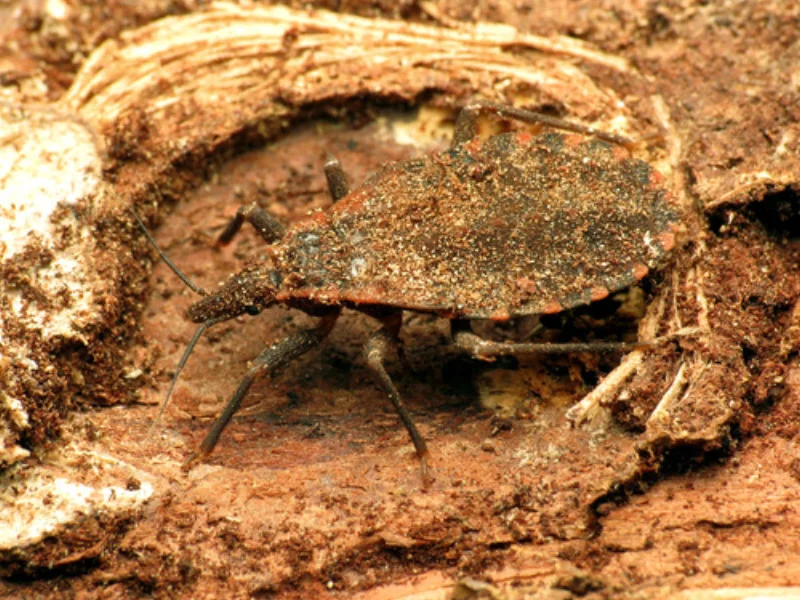
When Kissing Bugs Are Most Active in Colorado
Now (November): Lower Outdoor ActivityVerified Colorado Counties, Species & US Range
Counties with Verified Observations
- Adams
- Montezuma
- Pueblo
Species Recorded in Colorado
| Species | Scientific Name | GBIF Records |
|---|---|---|
| Western Conenose | Triatoma protracta | 7 |
| Triatoma gerstaeckeri | Triatoma gerstaeckeri | 1 |
How Colorado Compares to Neighboring States
Note: Wildlife does not follow state or county lines. GBIF totals reflect verified citizen and museum records, so low counts in a neighboring county do not guarantee absence.
How to Identify Kissing Bugs
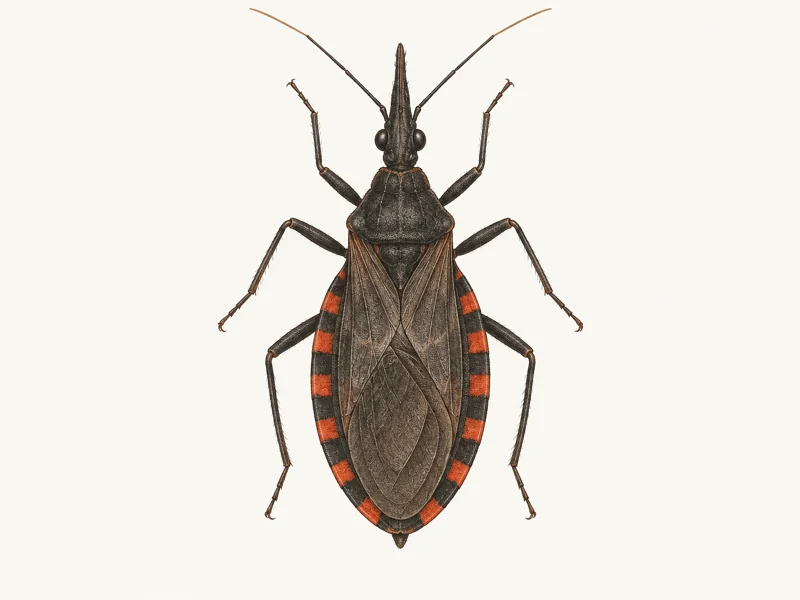
Annotated Anatomy Key (Kissing Bug)
- Cone-shaped head: Narrow, elongated cone-shaped head with a straight 3-segmented beak tucked underneath.
- Overlapping wings: Flat oval dark-brown back covered by overlapping half-leathery, half-membranous wings.
- Six slender legs: Three pairs of thin, relatively uniform dark legs without widened leaf-like pads.
- Striped abdomen rim: Distinct alternating orange-red and black bars framing the outer edge of the abdomen (connexivum).
Kissing Bugs Field Checklist
- Elongated cone-shaped head with a straight, slender 3-segmented beak tucked underneath
- Dark brown to black body with distinct orange, red, or tan stripes along the outer abdomen rim
- Flat oval back with overlapping leathery/membranous wings
- Nocturnal blood-feeder; never crush with bare hands
Side-by-Side Look-Alike Comparisons
Kissing Bugs Size at True Relative Scale
Quick Answer: Yes, there are kissing bugs in Colorado, but they are rare. GBIF lists only 8 verified sightings statewide, mostly from Adams, Montezuma, and Pueblo counties, and records peak in October. Two species have been documented: the Western Conenose (Triatoma protracta) and Triatoma gerstaeckeri.
Where Kissing Bugs Live in Colorado
Kissing bugs (subfamily Triatominae) are blood-feeding assassin bugs that usually live alongside their wild hosts. In Colorado's semi-arid high plains and lower-elevation valleys, that means woodrat nests, rodent burrows, rock crevices, and debris piles. The state's low humidity, cold winters, and USDA zones 3b through 7a limit how many survive, which helps explain why so few have been recorded.
Verified GBIF records cluster in a few counties:
- Adams County: the northeastern plains near the Denver metro area
- Montezuma County: the dry southwestern corner near Cortez and Mesa Verde
- Pueblo County: warmer, lower-elevation grassland and canyon terrain in southern Colorado
The Western Conenose (Triatoma protracta) is often linked with woodrat dens in arid western habitats. Triatoma gerstaeckeri is more commonly associated with the southern plains. Neither species is known to be widespread in Colorado, and high alpine areas are unlikely habitat.
When Kissing Bugs Are Most Active in Colorado
Colorado's verified records peak in October. That fits a broader pattern in which adult kissing bugs disperse and fly toward lights on warm evenings, sometimes ending up near homes. As nights cool, a few may also wander indoors looking for shelter or hosts.
Outside of autumn, sightings are uncommon. Cold winters push the insects into sheltered nests and burrows, and activity in spring and summer stays low because the state's population is small. Homeowners in the top counties should watch most closely on mild fall nights when porch lights are on.
Look-Alikes Frequently Mistaken for Kissing Bugs
Most "kissing bugs" reported in Colorado turn out to be harmless look-alikes. For accurate Colorado kissing bug identification, check for a narrow, cone-shaped head, thin antennae coming from the sides of that head, and orange or red bands along the flattened abdomen edges. Adults are about 0.5 to 1 inch long.
Stink Bugs
Stink bugs have a broad, shield-shaped body and a short, wide head. They release a strong odor when disturbed and feed on plants, not blood.
Boxelder Bugs
Boxelder bugs are black with red-orange lines on the back and wing edges, which leads to confusion. However, they have a small, rounded head rather than a long cone, and they gather in large groups on sunny walls in fall. They do not bite people for blood.
Cockroaches
Cockroaches are flat and brown, but their long, whip-like antennae, fast running, and hidden head under a shield-like pronotum set them apart. They scavenge food and do not feed on blood.
How to Keep Kissing Bugs Out of Your Colorado Home
Because kissing bugs are rare in the state, prevention focuses on simple Integrated Pest Management (IPM) steps that also discourage rodents and other pests. Cooperative extension IPM guidance consistently ranks exclusion and habitat reduction ahead of chemical treatments.
- Seal entry points: caulk cracks around the foundation, windows, and utility lines, and repair torn screens and door sweeps.
- Manage lighting: turn off porch lights in fall or switch to yellow bug lights, and close blinds at night.
- Reduce rodent habitat: remove woodpiles, rock piles, and brush near the house, and address any woodrat or mouse activity.
- Protect pets: keep dogs indoors at night when possible and keep kennels clean and raised off the ground.
- Inspect sleeping areas: check beds, pet bedding, and cracks near where people and animals sleep.
If an insecticide is ever needed, choose a product registered for the target pest and follow the EPA product label exactly. Label directions are legal requirements, not suggestions.
When to Call a Licensed Colorado Pest Professional
- More than one suspected kissing bug is found indoors
- Bugs are found in bedrooms, pet sleeping areas, or kennels
- Signs of rodent nests sit close to or inside the home
- Nymphs (smaller, wingless bugs) appear, which may suggest breeding nearby
Health note: Some kissing bugs can carry the parasite that causes Chagas disease. This guide does not provide medical advice. If someone is bitten or has a reaction, contact a doctor or call US Poison Control at 1-800-222-1222. Do not crush a suspected kissing bug with bare hands; capture it in a sealed container for identification.
IPM Prevention Checklist for Colorado Homes
- Repair torn window screens and install tight door sweeps
- Keep outdoor pets indoors at night and move wood/rock piles away from the house
- Turn off bright porch lights that attract adult bugs at night
 EXCLUSION BLUEPRINT
Inspect eaves, screens, door sweeps, foundation cracks, and utility penetrations around Colorado homes before peak season.
Kissing Bugs in Colorado: Frequently Asked Questions
Are there kissing bugs in Colorado?
Yes, but they are rare. GBIF has only 8 verified Colorado sightings, mainly from Adams, Montezuma, and Pueblo counties.
When is Colorado kissing bug season?
Verified records peak in October, when adults are more likely to fly toward lights on warm fall evenings.
Which kissing bug species live in Colorado?
Two species have been recorded: the Western Conenose (Triatoma protracta) and Triatoma gerstaeckeri.
What should someone do with a suspected kissing bug?
Avoid touching it with bare hands, place it in a sealed container, and have it identified by an extension office or pest professional. For any bite concerns, call a doctor or US Poison Control at 1-800-222-1222.
Sources & Verification
- Texas A&M Kissing Bug Citizen Science Program
- CDC — Triatomine Bugs (Kissing Bugs)
- GBIF Global Biodiversity Occurrence Records
Data refreshed · Editorial & GBIF Methodology