Japanese Beetles in California: Status, Identification, and Prevention
Quick Answer: Japanese beetles (Popillia japonica) are rare in California. GBIF lists just one verified sighting, with activity recorded in July. Most shiny beetles homeowners find in the state are look-alikes, so careful identification matters before anyone treats a yard.
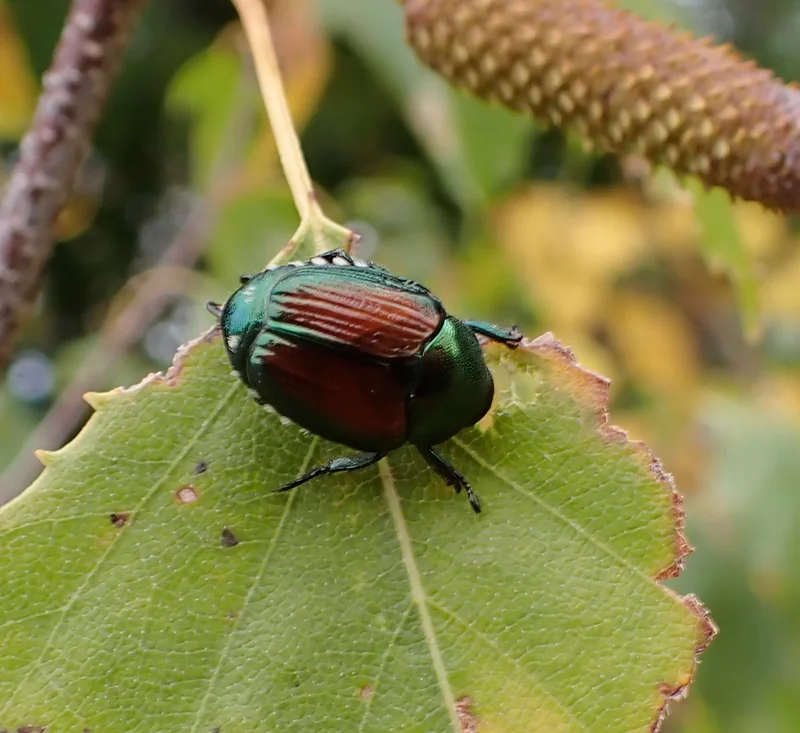
When Japanese Beetles Are Most Active in California
Now (November): Lower Outdoor ActivityJapanese Beetles Range in California vs. Neighboring States
How California Compares to Neighboring States
Note: Wildlife does not follow state or county lines. GBIF totals reflect verified citizen and museum records, so low counts in a neighboring county do not guarantee absence.
How to Identify Japanese Beetles
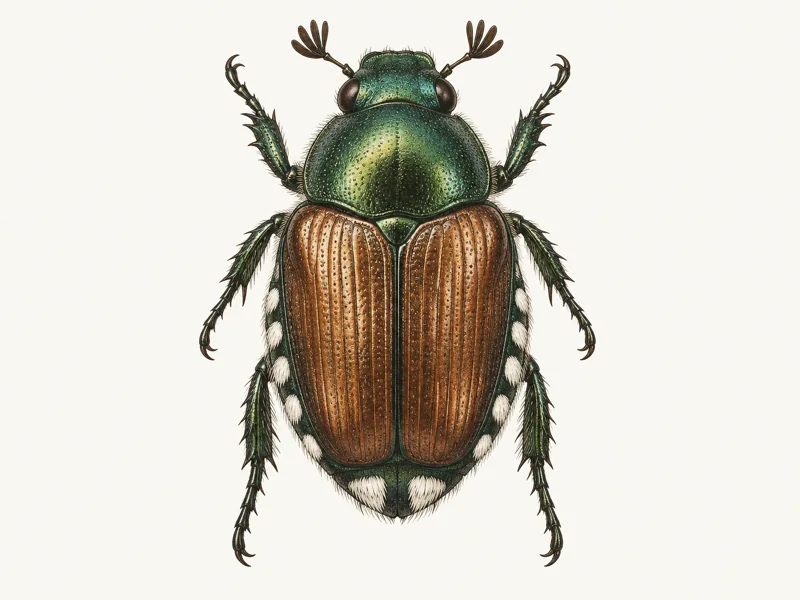
Annotated Anatomy Key (Japanese Beetle)
- Metallic green shield: Iridescent emerald-green head and pronotum gleaming brightly in summer sun.
- Copper-bronze elytra: Ribbed coppery-brown hardened wing covers stop slightly short of the tail tip.
- Six metallic spiny legs: Dark green clawed legs cling tightly to roses, linden leaves, and fruit trees.
- Five white side tufts: Unmistakable row of 5 crisp white hair spots along each side plus 2 at the tip.
Japanese Beetles Field Checklist
- Metallic emerald-green head and thorax with iridescent coppery-bronze wing covers
- Row of five crisp white hair tufts along each side of the abdomen
- Skeletonizes rose, linden, raspberry, and grape leaves into lacy patterns in summer
- White C-shaped soil grubs feed on turfgrass roots in late summer and spring
Side-by-Side Look-Alike Comparisons
Japanese Beetles Size at True Relative Scale
Where Japanese Beetles Live in California
So, are there Japanese beetles in California? Only barely. GBIF holds a single verified occurrence, and the county data are limited, so no area of the state can be called an established population.
California spans Mediterranean coastal climates, arid inland deserts, and alpine mountain zones (USDA zones 5a-11a). Japanese beetles are native to Japan and are best known as a pest of the eastern United States. General entomology sources and university extension IPM guidance describe their grubs as dependent on moist, turf-covered soil, which makes irrigated lawns the most likely habitat if the beetle ever turns up.
The danger level is classed as a nuisance. They do not sting or bite people, but adults can feed heavily on plants.
How to Recognize an Adult
California Japanese beetle identification comes down to a few features. Check for all of these:
- Size: about 3/8 to 1/2 inch long, oval-bodied.
- Color: metallic green head and thorax with coppery-brown wing covers.
- White tufts: five small white hair patches along each side of the abdomen, plus two at the tip.
- Feeding damage: leaves chewed into lace-like skeletons between the veins.
The white tufts are the most reliable field mark. If you cannot see them, you are probably not looking at a Japanese beetle.
When Japanese Beetles Are Most Active in California
The single GBIF record falls in July, which matches the adult flight period described for the species elsewhere in the country. In general, adults emerge in early to midsummer, feed for several weeks, and lay eggs in turf. A true California Japanese beetle season, in the sense of regular annual activity, has not been documented.
Grubs feed on grass roots through late summer and early fall, then burrow deeper in cold weather. They resume feeding briefly in spring before pupating. Because records are so sparse, treat any summer find as something to verify rather than assume.
Look-Alikes Frequently Mistaken for Japanese Beetles
Two common California insects cause most false alarms.
June Bugs (May Beetles)
These are stocky, uniformly brown to reddish-brown beetles that come to porch lights at night. They lack the metallic green head and the white abdominal tufts. Their grubs also feed on roots, which adds to the confusion.
Asian Lady Beetles
These are rounded, orange to red beetles, often with black spots, and a white marking behind the head. They eat aphids rather than leaves. They are generally beneficial in gardens, though they may gather on house walls in fall.
- Brown, no metallic sheen: likely a June bug.
- Orange and domed: likely an Asian lady beetle.
- Green head, bronze wings, white side tufts: possible Japanese beetle.
How to Keep Japanese Beetles Out of Your California Home
Anyone wondering how to prevent Japanese beetles in California should start with non-chemical steps. Prevention is mostly about not importing them and not offering a welcoming yard.
- Inspect incoming plants: check nursery stock and the soil of potted plants for grubs, especially if purchased out of state.
- Avoid moving soil and turf: do not carry sod or soil from areas where the beetle is established.
- Manage moisture: avoid overwatering lawns in summer, since wet turf attracts egg-laying beetles and supports grubs.
- Hand-pick adults: knock beetles into a bucket of soapy water in the morning, when they are sluggish.
- Keep plants healthy: vigorous plants tolerate leaf feeding better.
If a chemical product is ever considered, choose one labeled for the specific pest and site, and follow the EPA label exactly. Broad spraying can harm pollinators and beneficial insects.
When to Call a Licensed California Pest Professional
- You find a beetle with all the identifying features, especially more than one.
- Skeletonized leaves appear on several plants and hand-picking is not keeping up.
- You find C-shaped grubs in turf along with dying patches.
Save the specimen in a sealed container or freezer and contact your county agricultural commissioner. Because the beetle is regulated as a potential invasive pest, a confirmed find should be reported rather than treated alone.
IPM Prevention Checklist for California Homes
- Avoid placing pheromone Japanese beetle bag traps in your yard—university studies show they attract far more beetles to nearby plants than they catch
 EXCLUSION BLUEPRINT
Inspect eaves, screens, door sweeps, foundation cracks, and utility penetrations around California homes before peak season.
Japanese Beetles in California: Frequently Asked Questions
Are there Japanese beetles in California?
Barely. GBIF shows one verified sighting, so the species is considered rare and not established statewide.
Do Japanese beetles bite or sting?
No. They are a plant-feeding nuisance and are not a medical concern. If anyone has an unusual reaction to any insect, call Poison Control at 1-800-222-1222 or see a doctor.
What month are Japanese beetles seen in California?
The one recorded sighting was in July, which fits the typical summer adult flight period.
What should I do if I think I found one?
Photograph it, check for the white side tufts, save the specimen, and contact your county agricultural commissioner for confirmation.
Sources & Verification
Data refreshed · Editorial & GBIF Methodology