Asian Lady Beetles in the United States
US Overview: Asian lady beetles (Harmonia axyridis) are dome-shaped orange, yellow, or red beetles, 5-8 mm long, with 0 to 19 black spots and a distinct black "M" or "W" marking on the white plate behind the head. GBIF holds 211,079 US records across 48 states, with the most in Texas, California, New York, Virginia, North Carolina, and Massachusetts.
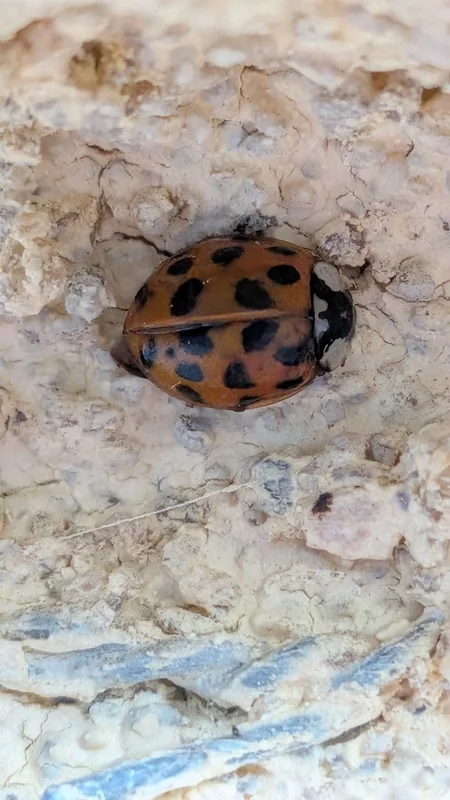
When Asian Lady Beetles Are Most Active in the US
Now (November): Moderate Activity50-State US Distribution Map
Asian Lady Beetles Size at True Relative Scale
Key Identification Features & Anatomy
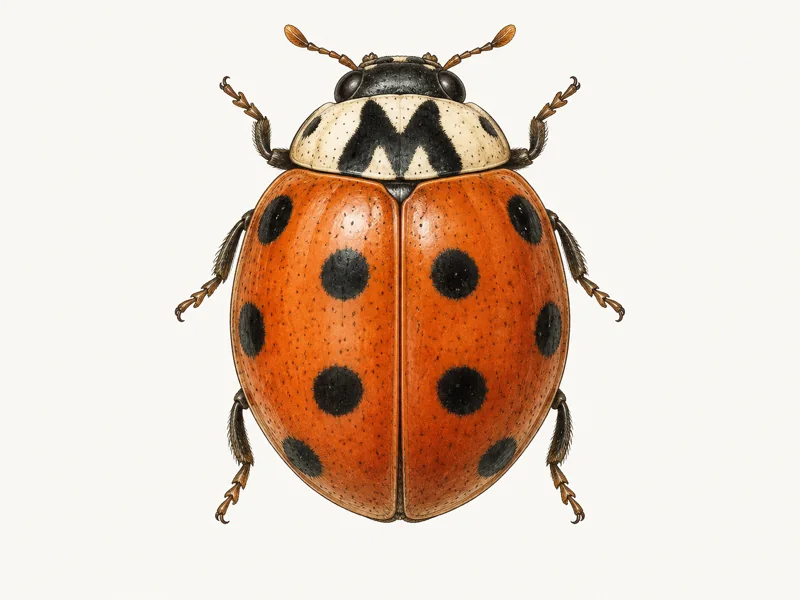
Annotated Anatomy Key (Asian Lady Beetle)
- Black M-shaped mark: Diagnostic black M (or W facing head-on) centered on the creamy-white pronotum.
- Domed orange elytra: Glossy burnt-orange to yellow-orange shell carrying 0 to 19 symmetrical black spots.
- Short tucked legs: Six compact dark legs; may emit yellow defensive fluid when startled indoors.
- Rounded oval shell: Slightly larger (5–8 mm) and more oval than native seven-spotted ladybugs.
Asian Lady Beetles Field Checklist
- Dome-shaped orange, yellow, or red beetle with 0 to 19 black spots
- Identified from native ladybugs by the distinct black 'M' or 'W' marking on the white plate behind the head
- Congregates on sunny house walls in October seeking winter shelter
- Secretes a yellow staining defensive fluid ('reflex bleeding') and can pinch lightly
Quick Answer: Asian lady beetles (Harmonia axyridis) are dome-shaped orange, yellow, or red beetles, 5-8 mm long, with 0 to 19 black spots and a distinct black "M" or "W" marking on the white plate behind the head. GBIF holds 211,079 US records across 48 states, with the most in Texas, California, New York, Virginia, North Carolina, and Massachusetts. They are a household nuisance, not a medical threat.
Physical Identification & Biology
Asian lady beetle identification starts with shape and color. Adults are rounded, dome-shaped beetles measuring 5-8 mm, slightly larger than many native ladybugs. Their color ranges widely from pale yellow to deep orange or red, so color alone is not a reliable clue.
Spot count also varies. Individuals can carry anywhere from 0 to 19 black spots, and some appear completely spotless. The most dependable feature is the pronotum, the white plate just behind the head, which bears a black marking shaped like an "M" or a "W," depending on viewing angle.
Key Identification Traits
- Size: 5-8 mm, oval and strongly domed
- Color: Orange, yellow, or red wing covers
- Spots: 0 to 19 black spots
- Signature mark: Black "M" or "W" on a white pronotum
- Defense: Yellow, staining fluid released from leg joints ("reflex bleeding")
Like other lady beetles, this species is a predator of aphids and other soft-bodied insects in gardens and crops. That benefit outdoors is why many growers tolerate them, even as homeowners find them a fall nuisance.
US Range & Peak Activity States
For anyone asking where Asian lady beetles live in the US, the answer is nearly everywhere. GBIF data lists 211,079 US observation records spanning 48 states, making this one of the most widely documented beetles in the country.
Top Reporting States
- Texas
- California
- New York
- Virginia
- North Carolina
- Massachusetts
Record counts partly reflect where observers are active, so a lower count in a given state does not mean the beetle is rare there. Homeowners across most of the country should expect to encounter them.
Peak Months
US records peak in May, June, August, and September, when beetles are actively feeding and breeding outdoors. A second, very visible wave follows in October, when adults gather on sunny house walls looking for winter shelter.
Habitat, Behavior & Risk Level
Asian lady beetle habitat includes gardens, orchards, crop fields, woodland edges, and landscaped yards wherever aphids are plentiful. During the growing season they stay outdoors and rarely bother people.
Behavior shifts in fall. In October, beetles congregate on the sunny, south- and west-facing sides of homes, especially light-colored walls. From there they slip through gaps around windows, siding, and attic vents, then overwinter inside walls and may wander into living spaces on warm days.
Are Asian Lady Beetles Dangerous?
They are classified as a nuisance pest. They do not bite or sting in any medically meaningful way, though they can pinch lightly when handled. The yellow reflex-bleeding fluid smells unpleasant and can stain walls, curtains, and fabrics.
Some people report sensitivities around large indoor infestations. Anyone with persistent symptoms should consult a doctor rather than self-treat.
Look-Alikes & Prevention Overview
Several common household invaders are mistaken for Asian lady beetles, particularly in fall.
- Native ladybugs: Usually smaller and lack the distinct "M" or "W" pronotum mark.
- Carpet beetles: Much smaller, mottled with brown, white, and yellow scales, and found near fabrics.
- Stink bugs: Flat, shield-shaped, and brownish rather than domed and bright.
- Boxelder bugs: Elongated, black with red-orange lines, and also cluster on sunny walls in fall.
Non-Chemical Prevention First
- Seal cracks around windows, doors, utility lines, and fascia with caulk before October.
- Repair torn screens and add screening to attic and soffit vents.
- Install door sweeps and weatherstripping.
- Vacuum indoor beetles with a stocking inside the hose, then discard; avoid crushing them to prevent stains.
- Use light traps in attics or quiet rooms for ongoing captures.
If exclusion is not enough, a licensed pest professional can apply exterior perimeter treatments in early fall. Any pesticide use must strictly follow the EPA-registered product label.
Asian Lady Beetles by US State
States with dedicated field guides link straight to their state distribution sheet; other states link to their state pest calendar.
| State | Status | GBIF Records | Peak Activity |
|---|---|---|---|
| Texas | Common & Established | 22,962 | May, Jun, Aug |
| California | Common & Established | 18,427 | May, Jun, Aug |
| New York | Common & Established | 13,095 | May, Jun, Aug |
| Virginia | Common & Established | 11,086 | May, Jun, Aug |
| North Carolina | Common & Established | 10,364 | May, Jun, Aug |
| Massachusetts | Common & Established | 9,603 | May, Jun, Aug |
| Pennsylvania | Common & Established | 9,195 | May, Jun, Aug |
| Ohio | Common & Established | 7,968 | May, Jun, Aug |
| Florida | Common & Established | 7,938 | May, Jun, Aug |
| Maryland | Common & Established | 7,338 | May, Jun, Aug |
| Illinois | Common & Established | 6,292 | May, Jun, Aug |
| Georgia | Common & Established | 6,177 | May, Jun, Aug |
| Vermont | Common & Established | 5,950 | May, Jun, Aug |
| Minnesota | Common & Established | 5,045 | May, Jun, Aug |
| Michigan | Common & Established | 4,928 | May, Jun, Aug |
| Tennessee | Common & Established | 4,570 | May, Jun, Aug |
| New Jersey | Common & Established | 4,504 | May, Jun, Aug |
| Washington | Common & Established | 4,287 | May, Jun, Aug |
| Wisconsin | Common & Established | 4,204 | May, Jun, Aug |
| Alabama | Common & Established | 3,913 | May, Jun, Aug |
| Oregon | Common & Established | 3,673 | May, Jun, Aug |
| Indiana | Common & Established | 3,570 | May, Jun, Aug |
| Missouri | Common & Established | 2,932 | May, Jun, Aug |
| South Carolina | Common & Established | 2,669 | May, Jun, Aug |
| Connecticut | Common & Established | 2,628 | May, Jun, Aug |
| Maine | Common & Established | 2,214 | May, Jun, Aug |
| Colorado | Common & Established | 2,211 | May, Jun, Aug |
| Kentucky | Common & Established | 2,073 | May, Jun, Aug |
| Louisiana | Common & Established | 2,030 | May, Jun, Aug |
| Delaware | Common & Established | 1,992 | May, Jun, Aug |
| New Hampshire | Common & Established | 1,749 | May, Jun, Aug |
| Oklahoma | Common & Established | 1,608 | May, Jun, Aug |
| Arkansas | Common & Established | 1,519 | May, Jun, Aug |
| Kansas | Common & Established | 1,424 | May, Jun, Aug |
| Iowa | Common & Established | 1,403 | May, Jun, Aug |
| Utah | Common & Established | 1,234 | May, Jun, Aug |
| West Virginia | Common & Established | 1,230 | May, Jun, Aug |
| Mississippi | Common & Established | 1,035 | May, Jun, Aug |
| Nebraska | Common & Established | 913 | May, Jun, Aug |
| Rhode Island | Common & Established | 907 | May, Jun, Aug |
| Idaho | Common & Established | 832 | May, Jun, Aug |
| South Dakota | Common & Established | 490 | May, Jun, Aug |
| New Mexico | Common & Established | 361 | May, Jun, Aug |
| Montana | Common & Established | 307 | May, Jun, Aug |
| North Dakota | Common & Established | 216 | May, Jun, Aug |
| Nevada | Common & Established | 142 | May, Jun, Aug |
| Arizona | Present | 62 | May, Jun, Aug |
| Wyoming | Present | 56 | May, Jun, Aug |
| Alaska | Not Established | 0 | — |
| Hawaii | Not Established | 0 | — |
Frequently Asked Questions
How can someone tell an Asian lady beetle from a native ladybug?
Look at the white plate behind the head. Asian lady beetles have a black "M" or "W" marking there, while most native ladybugs do not.
Do Asian lady beetles bite?
They do not bite or sting, but they can pinch lightly. The pinch is harmless for most people and is more surprising than painful.
Why do they swarm houses in the fall?
In October, adults gather on warm, sunny walls while searching for protected sites to overwinter. Gaps in siding and windows lead them indoors.
What causes the yellow stains they leave?
The stains come from reflex bleeding, a defensive fluid released from their leg joints. Vacuuming instead of swatting helps prevent these marks.
References & Data Sources
- Ohio State University Extension — Multicolored Asian Lady Beetle
- GBIF Global Biodiversity Occurrence Records
Data last refreshed: 2026-11-25