Centipede vs Earwig: How to Tell Them Apart Fast
Quick ID Verdict: A centipede has a long, flattened, segmented body with exactly one pair of legs on each segment, so it looks like a fast-moving strip of legs. An earwig has only six legs, a slender, flattened dark reddish-brown body, and a pair of pincers on its rear end.
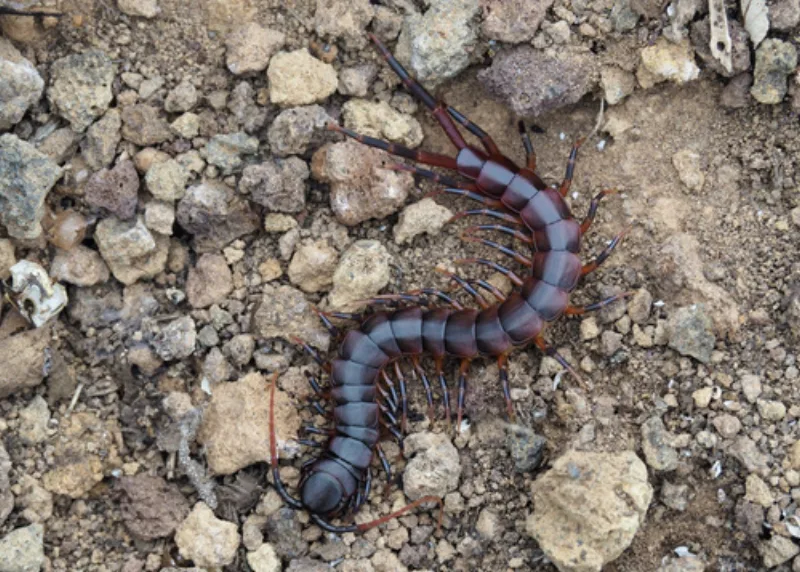
Centipede
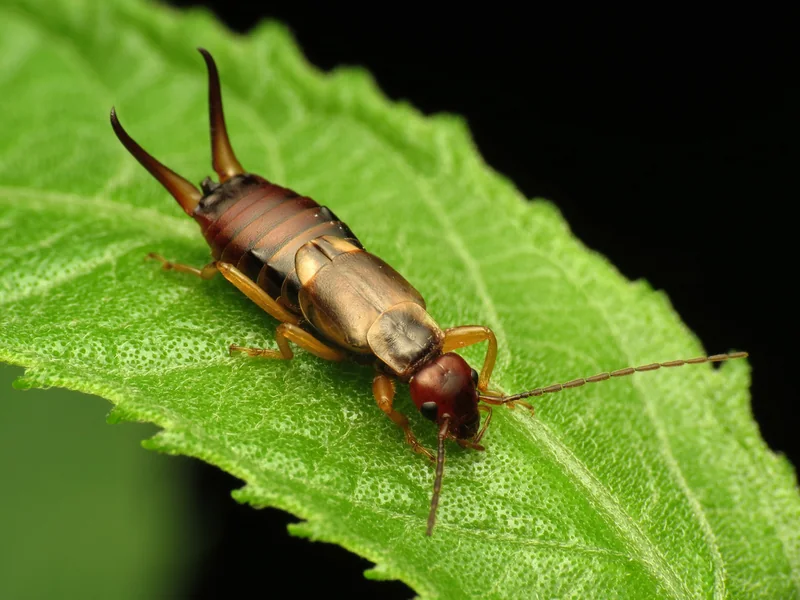
Earwig
Side-by-Side Comparison Table
| Trait | Centipede | Earwig |
|---|---|---|
| Scientific Group | Chilopoda | Dermaptera |
| Category | Myriapod | Insect |
| Typical Size | 25–180 mm | 12–22 mm |
| Danger Level | Nuisance | Nuisance |
| Bites or Stings? | Yes | No |
| Peak US Months | April, May, June, October | June, July, August, September |
| Key ID Trait | Flattened, elongated segmented body with exactly ONE pair of legs per body segment | Slender, flattened dark reddish-brown body |
Centipede vs. Earwig: True Size Comparison
Side-by-Side Anatomy Blueprint
Compare body segments, antennae, leg count, and key markings directly before treating or removing either species.
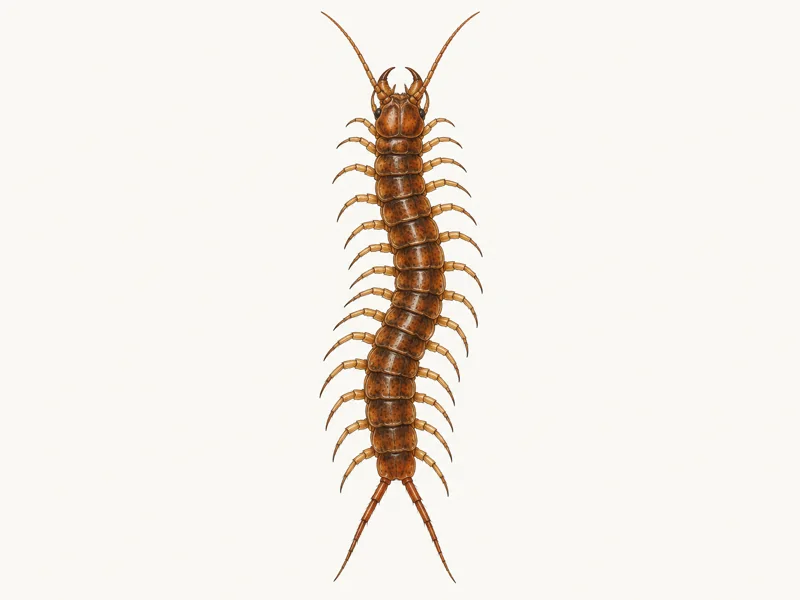
- Antennae & forcipules: Long segmented antennae and modified front venom claws (forcipules) behind the head.
- Flattened segments: Flat, flexible segmented trunk built for fast sprinting—never coils into a tight spiral.
- 1 leg pair / segment: EXACTLY ONE pair of legs extending outward per body segment (millipedes have two pairs).
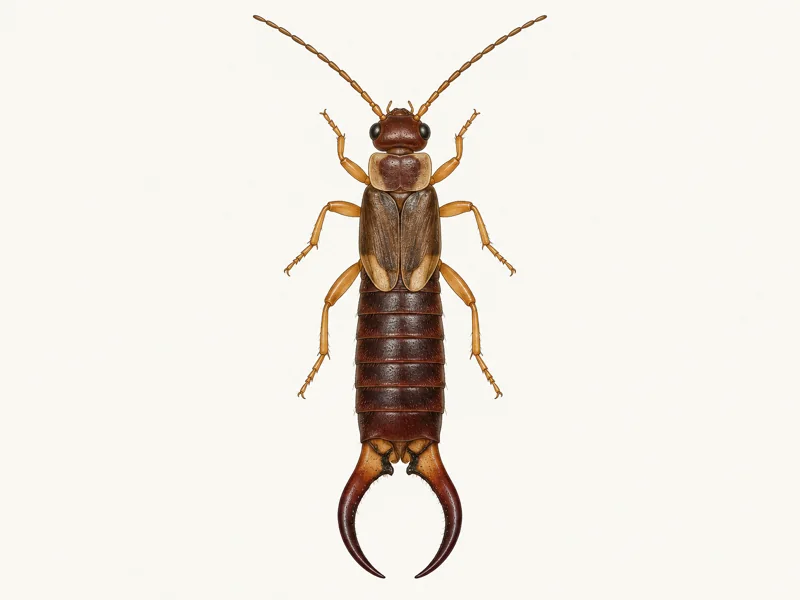
- Thread-like antennae: Segmented medium-length antennae on a flat chestnut-brown head.
- Short wing covers: Compact leathery forewings (tegmina) leave most of the flexible abdomen exposed.
- Six amber legs: Three pairs of slender pale tan legs suited for damp mulch and baseboard crevices.
Quick Answer: A centipede has a long, flattened, segmented body with exactly one pair of legs on each segment, so it looks like a fast-moving strip of legs. An earwig has only six legs, a slender, flattened dark reddish-brown body, and a pair of pincers on its rear end. Both are nuisance pests that thrive in damp areas, and moisture control is the best defense against either one.
Quick ID Verdict: Telling Them Apart in 3 Seconds
Count the legs and check the tail. If the creature has dozens of legs, one pair per body segment, it is a centipede; if it has six legs and rear pincers, it is an earwig.
That single check settles most centipede vs earwig identification questions. Size helps too, since centipedes range from 25 to 180 mm while earwigs stay between 12 and 22 mm.
Key Visual & Physical Differences
The difference between centipede and earwig anatomy is clear once you know what to look for. Centipedes belong to the class Chilopoda, while earwigs are true insects in the order Dermaptera.
Centipedes (Chilopoda)
- Size: 25-180 mm long, depending on species.
- Body: Flattened, elongated, and clearly segmented.
- Legs: Exactly one pair of legs per body segment, giving them many legs in total.
- Head: Long antennae and a pair of venom claws (forcipules) just behind the head.
- Movement: Very fast, often darting across floors and walls.
Earwigs (Dermaptera)
- Size: 12-22 mm long.
- Body: Slender, flattened, and dark reddish-brown.
- Legs: Six legs, like all insects, attached near the front of the body.
- Tail: A pair of curved pincers (cerci) at the tip of the abdomen.
- Wings: Short wing covers; many species rarely fly.
If you only catch a glimpse, think "many legs, no pincers" for a centipede and "few legs, rear pincers" for an earwig.
Behavior, Habitat & Danger Comparison
Both pests are nocturnal and drawn to dampness. You will usually find them in basements, bathrooms, crawl spaces, laundry rooms, and under mulch or stones outdoors.
Centipede Behavior
Centipedes are predators that hunt spiders, silverfish, and other small insects. Indoors, they usually signal a damp space with an existing food supply.
Earwig Behavior
Earwigs are scavengers that feed on decaying plant matter, small insects, and sometimes tender seedlings or soft fruit. They often wander indoors during dry or hot spells, hiding in cracks, under rugs, or in folded laundry.
Danger Level
Both are rated as nuisance pests. Larger centipedes can bite if handled, causing local pain and swelling, while earwig pincers may give a mild pinch. Neither infests food, damages structures, or lays eggs in human ears, which is a long-running myth.
If anyone has a strong reaction after a bite, such as spreading swelling or trouble breathing, contact US Poison Control at 1-800-222-1222 and see a doctor. Do not rely on home remedies.
Which One Is Worse for Homeowners?
For most households, neither pest is a serious threat, but each brings its own annoyance. Centipedes are more startling because of their speed, size, and ability to bite. Earwigs are more likely to appear in large numbers and can nibble garden plants.
Integrated Pest Management Steps
Whether you are dealing with a centipede or earwig problem, start with non-chemical controls that target moisture and entry points.
- Reduce moisture: Run a dehumidifier, fix leaky pipes, and improve crawl space ventilation.
- Seal entry points: Caulk gaps around foundations, windows, and utility lines, and add door sweeps.
- Clear the perimeter: Pull mulch, leaf litter, firewood, and stones back from the foundation.
- Cut the food supply: Controlling other household insects leaves centipedes with less to hunt.
- Trap earwigs: Rolled damp newspaper or shallow oil traps placed overnight can collect earwigs for disposal.
- Vacuum strays: A vacuum removes visible pests without chemicals.
If pests persist, a targeted perimeter treatment may help. Always read and follow the EPA product label, which is the legal guide for safe and effective use. For heavy or recurring activity, a licensed pest professional can find hidden moisture sources.
Frequently Asked Questions
Is a centipede or earwig more dangerous?
Both are nuisance pests. Large centipedes can deliver a painful bite if handled, while earwigs usually give only a mild pinch. Call Poison Control at 1-800-222-1222 for any strong reaction.
Do earwigs really crawl into ears?
No. This is an old myth. Earwigs hide in tight, damp spaces, but they show no special attraction to human ears.
Why am I seeing centipedes and earwigs together?
Both are drawn to damp, dark areas. Seeing them together often points to excess moisture in a basement, crawl space, or around the foundation.
Should I kill house centipedes?
House centipedes eat other household pests, so some homeowners tolerate a few. If they bother you, reduce moisture and seal gaps rather than relying only on sprays.