Pantry Moths in California: Identification, Season, and Prevention
Quick Answer: Pantry moths in California are almost always Indianmeal moths (Plodia interpunctella), a common nuisance pest of stored food. GBIF records 615 verified sightings in the state, with activity peaking in April and again from July through September. They do not bite or sting, and the fix is sanitation, not spraying.
When Pantry Moths (Indianmeal Moths) Are Most Active in California
Now (November): Moderate ActivityPantry Moths (Indianmeal Moths) Range in California vs. Neighboring States
How California Compares to Neighboring States
Note: Wildlife does not follow state or county lines. GBIF totals reflect verified citizen and museum records, so low counts in a neighboring county do not guarantee absence.
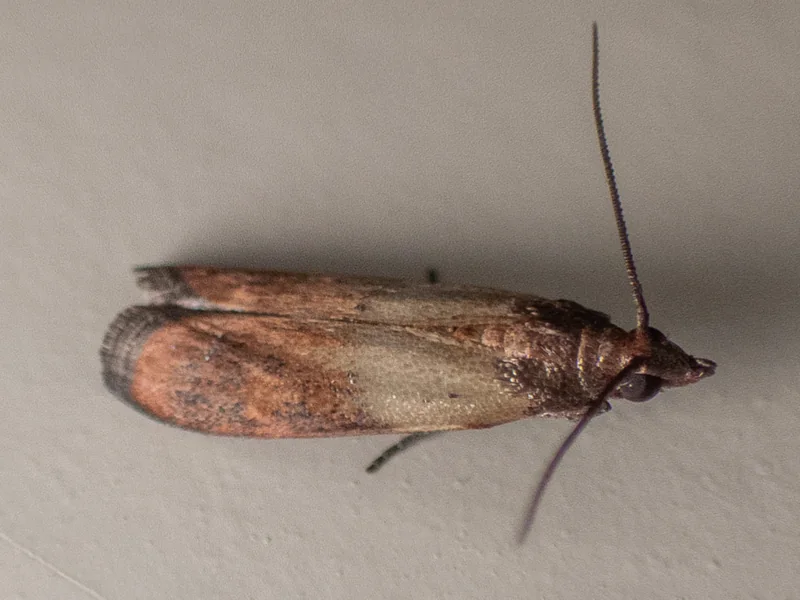
How to Identify Pantry Moths (Indianmeal Moths)
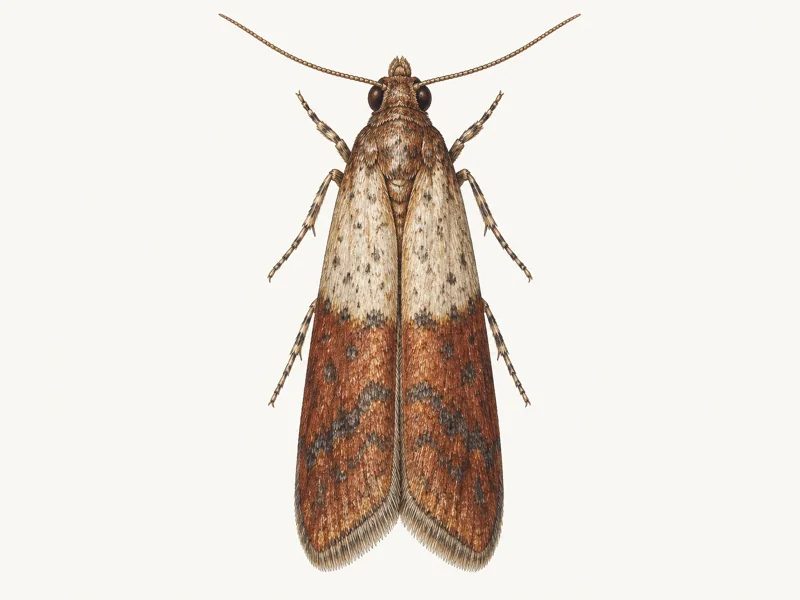
Annotated Anatomy Key (Pantry Moth)
- Swept-back antennae: Slender thread-like antennae held back over narrow folded wings (8–10 mm).
- Pale cream wing base: Inner third of forewings nearest the head is distinctly pale grayish-cream.
- Coppery-bronze outer wings: Outer two-thirds shift sharply to rich coppery reddish-brown with dark flecks.
- Two-toned resting profile: Unmistakable split coloration distinguishes pantry moths from solid-gold clothes moths.
Pantry Moths (Indianmeal Moths) Field Checklist
- Distinctive two-toned wings: pale grayish-tan inner third and coppery reddish-brown outer two-thirds
- Creamy-white caterpillars with brown heads spin silken webbing inside flour, cereal, nuts, and pet food
- Adults flutter erratically in kitchens at dusk
Side-by-Side Look-Alike Comparisons
Pantry Moths (Indianmeal Moths) Size at True Relative Scale
Where Pantry Moths (Indianmeal Moths) Live in California
Are there pantry moths in California? Yes. The species is established statewide and is listed as common, with 615 verified GBIF sightings. County-level records are limited, so the sightings reflect where people report moths, not where the species is absent. California's range of climates, from Mediterranean coast to arid desert to alpine zones (USDA 5a-11a), does not stop an indoor pest.
The moths live where food is stored: kitchen pantries, warehouses, grocery stores, pet food storage, and bulk bins. Indoors, the climate outside matters little because a heated pantry stays suitable year-round.
Quick identification
For California pantry moth identification, look for these traits:
- Adults: about 1/2 inch long, with wings that are gray or tan on the inner half and copper or reddish-brown on the outer half.
- Larvae: small off-white caterpillars, often with a brownish head, found inside food packages.
- Webbing: silky threads and clumped food, especially in grains, cereal, dried fruit, nuts, chocolate, and pet food.
- Behavior: adults fly in a zigzag pattern, often at dusk, and rest on walls and ceilings.
When Pantry Moths (Indianmeal Moths) Are Most Active in California
The California pantry moth season shows peaks in April and in July, August, and September in GBIF records. Warm temperatures speed up development, so infestations can grow quickly in summer. Larvae can complete a life cycle in roughly a month or two in warm conditions, and a cooler pantry slows it down.
Indoors, activity can continue in any month. If moths appear in winter, suspect infested food already in the home rather than moths arriving from outside.
Look-Alikes Frequently Mistaken for Pantry Moths (Indianmeal Moths)
Several small insects found in California homes get confused with pantry moths. Telling them apart helps you look in the right place.
- Clothes moths: small, uniformly golden or buff, and they avoid light. They feed on wool, fur, and feathers, not stored food.
- Drain flies (moth flies): fuzzy, moth-shaped flies with rounded wings, found near sinks, showers, and floor drains. They breed in slimy buildup inside pipes.
- Fruit flies: tiny tan flies hovering around ripe produce, trash, and recycling. They do not leave webbing in dry goods.
The two-toned wings and webbing in dry food point to Indianmeal moths. A fuzzy fly near a drain is not one.
How to Keep Pantry Moths (Indianmeal Moths) Out of Your California Home
How to prevent pantry moths in California comes down to sanitation and storage. University extension IPM guidance consistently recommends finding and removing the infested food first. Insecticide sprays are rarely needed and should never be applied to food or food-contact surfaces.
Non-chemical steps first
- Inspect: check every grain, cereal, flour, nut, dried fruit, spice, and pet food package for larvae, webbing, or clumping.
- Discard: seal infested items in a bag and take them to outdoor trash right away.
- Clean: vacuum shelves, corners, and shelf-pin holes, then wipe with soap and water.
- Store: keep dry goods in airtight glass, metal, or hard plastic containers. Thin plastic bags and cardboard do not stop larvae.
- Freeze: new bulk items can be frozen at 0°F for several days before storage to kill hidden eggs.
- Rotate: buy smaller amounts and use older stock first.
- Trap: pheromone traps catch males and help confirm activity, but they will not remove the source.
Chemical products
If you use any product, choose one labeled for the site and follow the EPA-registered label exactly. Do not spray inside food storage areas unless the label allows it.
When to call a licensed California pest professional
- Moths keep returning after you have discarded infested food and cleaned thoroughly.
- You cannot find the source, or larvae appear in several rooms.
- The infestation is in a restaurant, store, warehouse, or multi-unit building.
- Large amounts of stored food or pet feed are affected.
Pantry moths are a nuisance and not a venomous or medically significant pest. If anyone has an unusual reaction after contact with a pest or contaminated food, contact a doctor, or US Poison Control at 1-800-222-1222.
IPM Prevention Checklist for California Homes
- Transfer flour, rice, oats, nuts, and pet kibble into thick airtight glass or hard-plastic containers immediately after purchase
- Freeze newly purchased bulk grains or birdseed for 4 days at 0°F
 EXCLUSION BLUEPRINT
Inspect eaves, screens, door sweeps, foundation cracks, and utility penetrations around California homes before peak season.
Pantry Moths (Indianmeal Moths) in California: Frequently Asked Questions
Are pantry moths harmful to people?
They do not bite or sting and are considered a nuisance. They do contaminate food with larvae, webbing, and waste, so infested items should be thrown out.
Where do pantry moths come from?
Most arrive as eggs or larvae in packaged goods from stores or warehouses. They can also enter through open windows, though food is the usual source.
Can pantry moths chew through packaging?
Larvae can bore through thin plastic, foil, and cardboard, or slip through tiny gaps in poorly sealed packages. Airtight hard containers stop them.
Do pantry moths go away on their own?
Rarely. As long as infested food remains, they keep breeding. Removing the source and cleaning the shelves is what ends the problem.
Sources & Verification
Data refreshed · Editorial & GBIF Methodology