Clover Mites in Arizona: Identification, Season, and Prevention
Quick Answer: Clover mites (Bryobia praetiosa) are present in Arizona, with three verified GBIF sightings, so the answer to "are there clover mites in Arizona" is yes. Records peak in March, April, and May. They are a nuisance pest that does not bite people or spread disease, and non-chemical exclusion and moisture control handle most problems.
When Clover Mites Are Most Active in Arizona
Now (November): Lower Outdoor ActivityClover Mites Range in Arizona vs. Neighboring States
How Arizona Compares to Neighboring States
Note: Wildlife does not follow state or county lines. GBIF totals reflect verified citizen and museum records, so low counts in a neighboring county do not guarantee absence.
How to Identify Clover Mites
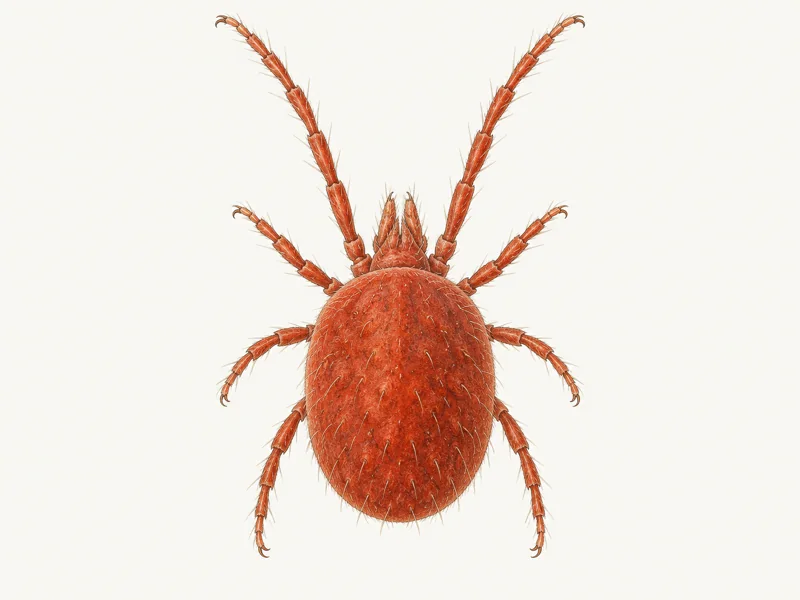
Annotated Anatomy Key (Clover Mite)
- Extra-long front legs: First leg pair extends far forward like antennae—the unmistakable hallmark of clover mites.
- Tiny mouthparts: Microscopic plant-feeding mouthparts at the front rim; completely wingless and harmless to humans.
- Eight jointed legs: Adult clover mites have 8 slender legs (no true antennae) and leave red smudges if crushed.
- Unsegmented oval body: Pinhead-sized brick-red to orange fused oval body lacking a distinct waist constriction.
Clover Mites Field Checklist
- Pinhead-sized brick-red to reddish-brown oval mite with an extra-long front pair of legs resembling antennae
- Appears by the thousands on sunny exterior siding and window sills in cool spring and fall weather
- Leaves bright rust-red stains on paint, curtains, and paper if squished
- Completely harmless—feeds strictly on grass and clover, never bites humans
Side-by-Side Look-Alike Comparisons
Clover Mites Size at True Relative Scale
Quick Answer: Clover mites (Bryobia praetiosa) are present in Arizona, with three verified GBIF sightings, so the answer to "are there clover mites in Arizona" is yes. Records peak in March, April, and May. They are a nuisance pest that does not bite people or spread disease, and non-chemical exclusion and moisture control handle most problems.
Where Clover Mites Live in Arizona
GBIF lists only three verified Arizona occurrences of Bryobia praetiosa, and county detail is limited. That likely reflects sparse reporting more than true rarity, so treat the data as a confirmation of presence rather than a map of hotspots.
Arizona spans arid southern desert lowlands, monsoon-influenced humidity, and cooler northern highlands (USDA zones 5a to 10a). Clover mites favor irrigated turf, groundcovers, and flower beds, so well-watered lawns and landscaped yards are the most likely habitat. Dry desert gravel yards offer far less for them to feed on.
These mites feed on plant sap from grasses, clover, and ornamentals. They gather on sunny building walls, foundations, and around windows, then wander indoors through small gaps.
When Clover Mites Are Most Active in Arizona
Arizona clover mite season, based on GBIF records, centers on March, April, and May. Cool-season conditions suit them, and they tend to fade as summer heat builds in the lowlands.
General entomology and university extension IPM guidance describes the same pattern across much of the country: spring and fall activity, with heat and dryness suppressing populations. Mites often move indoors on warm, sunny days following cool spells.
- Spring: Peak reports and the most indoor sightings.
- Summer: Activity usually drops in hot lowland areas.
- Cooler highland areas: Activity may extend later than in the desert.
Identifying Clover Mites
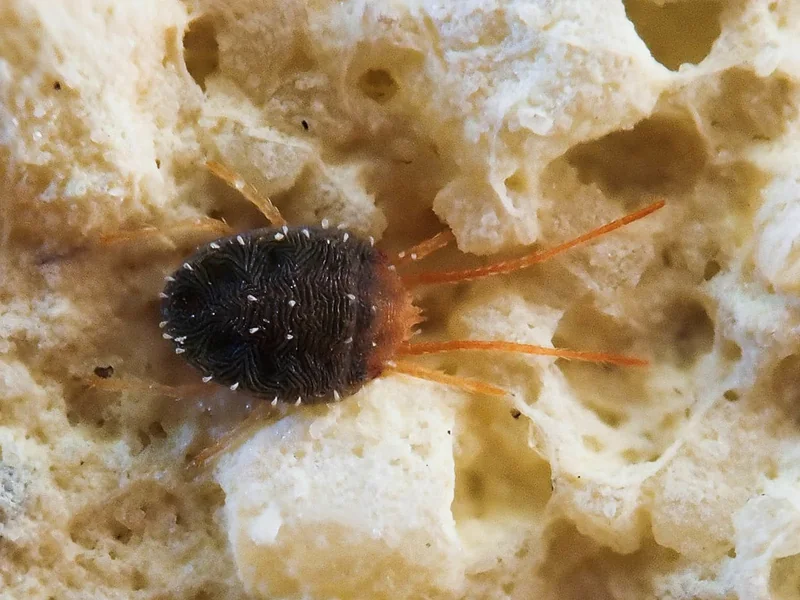
For Arizona clover mite identification, look closely. Adults are tiny, about 0.75 mm, and reddish-brown to green. The front pair of legs is noticeably long and extends forward like antennae.
A telltale sign is a red smear when one is crushed. This is pigment from the mite, not blood from a person or pet. Clover mites often appear in clusters on sunny sides of walls, window sills, and curtains.
Look-Alikes Frequently Mistaken for Clover Mites
Several small Arizona pests get confused with clover mites. The key difference is that clover mites do not bite or feed on people or pets.
- Chiggers: Also tiny and reddish, but larvae attach to skin and cause itchy welts. Clover mites do not.
- Ticks: Larger, eight-legged blood feeders that attach to hosts. Clover mites are far smaller and feed on plants.
- Fleas: Six-legged, flattened, dark insects that jump. Clover mites crawl slowly and have eight legs.
If you or a pet have bites, the cause is likely something else. For concerns about a bite or reaction, contact a doctor, or call US Poison Control at 1-800-222-1222.
How to Keep Clover Mites Out of Your Arizona Home
If you are wondering how to prevent clover mites in Arizona, start with non-chemical steps. Exclusion and landscape changes work better than spraying.
- Create a dry buffer: Keep a 18 to 24 inch strip of gravel, mulch-free soil, or hardscape between lawn and foundation.
- Seal entry points: Caulk cracks around windows, doors, and utility lines, and repair damaged screens and weatherstripping.
- Manage moisture: Avoid overwatering turf and beds near walls, and fix irrigation leaks.
- Trim plants: Keep vines, groundcover, and shrubs from touching the house.
- Remove indoors: Vacuum mites rather than wiping them, to avoid red stains on fabric and walls. Empty the vacuum outside.
If you use any pesticide, choose a product labeled for the site and pest, and follow the EPA label exactly. Never apply products in ways the label does not allow.
When to Call a Licensed Arizona Pest Professional
- Mites keep returning after exclusion and landscape changes.
- Large numbers appear indoors across multiple rooms.
- You are unsure of the identification, especially if bites are occurring.
- Treatment near foundations, irrigation, or landscape plantings requires label-compliant application.
IPM Prevention Checklist for Arizona Homes
- Create an 18-to-24-inch grass-free strip of pea gravel, bark, or bare mulch around foundations
- Caulk window frames and exterior foundation cracks
 EXCLUSION BLUEPRINT
Inspect eaves, screens, door sweeps, foundation cracks, and utility penetrations around Arizona homes before peak season.
Clover Mites in Arizona: Frequently Asked Questions
Are there clover mites in Arizona?
Yes. GBIF has three verified Arizona records of Bryobia praetiosa, though county-level detail is limited.
Do clover mites bite people or pets?
No. They feed on plants and are considered a nuisance. Their red stain when crushed is mite pigment, not blood.
When is clover mite season in Arizona?
Recorded activity peaks in March, April, and May. Hot summer weather typically reduces numbers in lowland areas.
What is the best first step to get rid of them?
Vacuum visible mites, seal entry gaps, and create a dry, plant-free strip along the foundation. Follow EPA label directions for any product you add.
Sources & Verification
Data refreshed · Editorial & GBIF Methodology